Tiger bags a roaring success for savings and waste
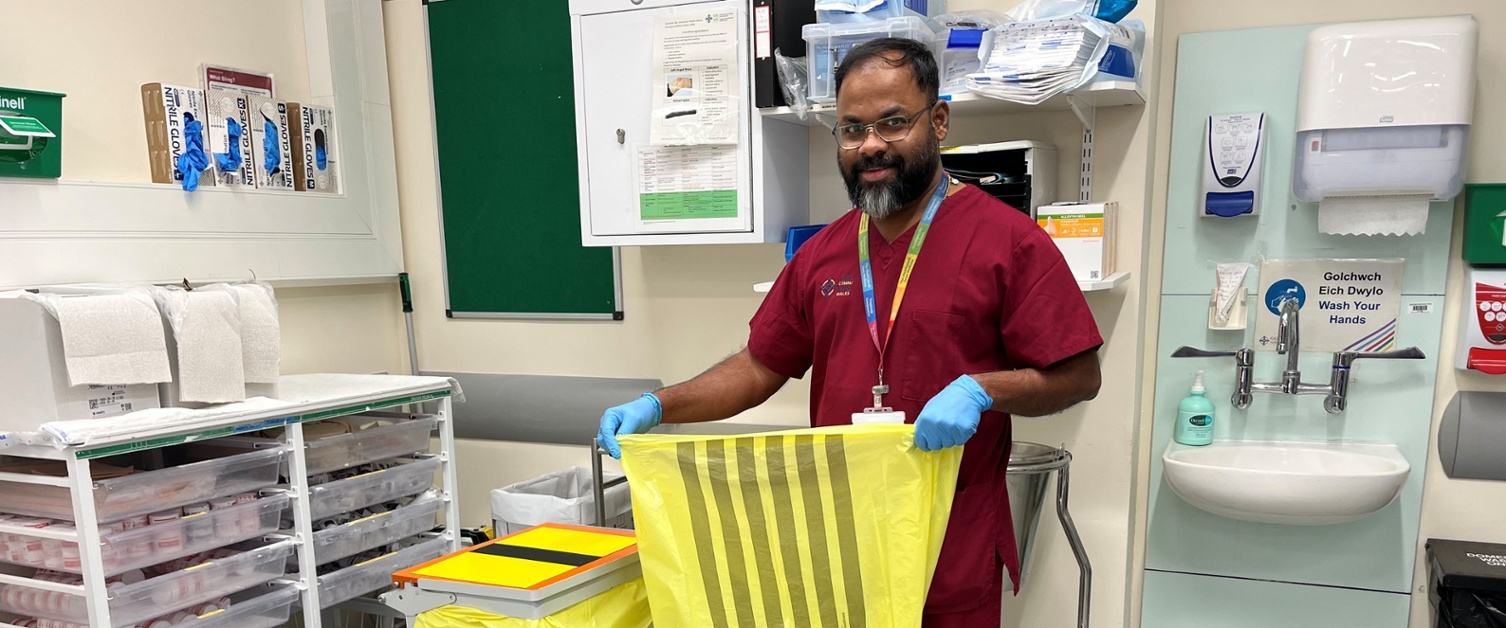
PICTURED: Domestic Assistant Josemon Kochukoshy with a Tiger bag being used in Morriston's Emergency Department.
A simple switch in the disposal of waste across two Swansea Bay hospitals has proved a roaring success.
The introduction of Tiger bags, which disposes non-infectious waste such as nappies, wipes, sanitary products and dressings and bandages, means waste is now being disposed of in a more environmentally-friendly way as they are instead recycled and used as a fuel in cement kilns or direct to energy from waste facilities.
The trial, in selected wards across Morriston and Singleton hospitals, has seen the health board’s Tiger bag disposal rising from two tonnes per month to up to 14. It could save up to £100,000 a year once rolled out throughout the health board.
While they have been used across some health board sites for the past few years, they are now being fully integrated and will reduce the use of orange bags, which are now being used specifically for the waste generated by patients who have specific infections only.
Morriston’s Emergency Department (ED) was among the first hospital service to trial the Tiger bags.
Sue West-Jones, ED Consultant and one of three Sustainable Clinical Leads in the health board, said: “This has been an excellent opportunity for us to improve our disposal of non-infectious waste, and the results from the trial in ED show it’s been a big success.
“Despite the ED being a very busy department, the staff have embraced the change and I am very grateful for their support. We’re making far better decisions for the environment and saving money for the health board that can be reinvested in care.
“Now that we’ve implemented these changes, I’m looking forward to Tiger bags being rolled out across the health board.”
Following the success of the initial trial, the health board will now implement the changes across more wards and services across its hospitals.
Ray Selby, Assistant Director Estates, said: “The health board has been reviewing its waste classification in collaboration with the regulator Natural Resources Wales, Infection Prevention and Control as well as individual wards and departments.
“The orange bags that are used across the hospital sites should only be used for known infectious waste such as barrier-nursed patients. This means the majority of clinical waste going into orange bags should be going in Tiger bags as offensive waste.
“So far as a health board we have saved around £5,500 in five months during the trial.
“This is going to continue to grow over the next few months as the other departments we have started trials in will have their data added.
“Once rolled out across the whole health board there will be an estimated saving of between £85,000 to £100,000 annually, as the Tiger bags clinical waste route is 20 per cent cheaper to dispose of than orange bag clinical waste.”
Rydym yn croesawu gohebiaeth a galwadau ffôn yn y Gymraeg neu'r Saesneg. Atebir gohebiaeth Gymraeg yn y Gymraeg, ac ni fydd hyn yn arwain at oedi. Mae’r dudalen hon ar gael yn Gymraeg drwy bwyso’r botwm ar y dde ar frig y dudalen.
We welcome correspondence and telephone calls in Welsh or English. Welsh language correspondence will be replied to in Welsh, and this will not lead to a delay. This page is available in Welsh by clicking ‘Cymraeg’ at the top right of this page.