Team facilitates earlier discharges to care for patients at home instead
Patients in hospital with a chronic lung condition are being helped home quicker – which is not just better for them but frees up beds for others.
Swansea Bay’s chronic obstructive pulmonary disease, COPD, team supports patients to live well with the condition and manage flare-ups, with the overall aim of avoiding hospital admissions.
But when patients are in hospital the team identifies those who can be discharged sooner, either from the wards or the Emergency Department, and supported to stay at home.
And the vast majority of them, currently 95 per cent, do not have to be readmitted.
During November, COPD Awareness Month, we’ll highlight the services, self-management guidance and support available to Swansea Bay patients.
COPD is a lung condition caused by damage to the airways or other parts of the lungs, resulting in breathing difficulties.
Common symptoms include shortness of breath, a persistent chesty cough with phlegm, frequent chest infections and persistent wheezing.
Alison Lewis, Swansea Bay’s respiratory clinical lead, said: “We have a team member in Morriston every day who seeks out patients who are suitable to go home sooner than they would normally.
“They can be discharged when it is safe to do so and then we can follow up with them in the comfort of their own homes.
“We always see the patients within 24 hours, or the next working day.
“It may be patients who have arrived at the Emergency Department or elsewhere.
“Once they are back home we can provide the support they need, whether it is helping with symptom management or educating them on self-management techniques.”
Patients identified by the team are typically those who have been taken to hospital with a flare-up of COPD, known as an exacerbation.
This is a sudden, temporary worsening of the symptoms beyond that which they typically experience.
It could result in increased breathlessness, coughing and changes in phlegm or increased wheezing, among other things.
“We want to get to patients much sooner before they arrive at hospital,” Alison added.
“We don’t want to wait until a patient is on the brink of a hospital admission, we want to intervene much earlier when they are more fit and well to help stop them deteriorating.”
If an identified inpatient cannot be discharged immediately, the team will look at ways of helping to safely speed up the process for them instead.
Alison said: “If there are any barriers preventing them from being discharged or any aspects that contributed to their admission, we start working on those elements rather than waiting for them to be fit to go home.
“We always advise ward staff that if they think a patient is suitable for us to come in and support, to contact us sooner rather than later and not to wait until the patient is ready to go home. We could have supported an earlier discharge for them.”
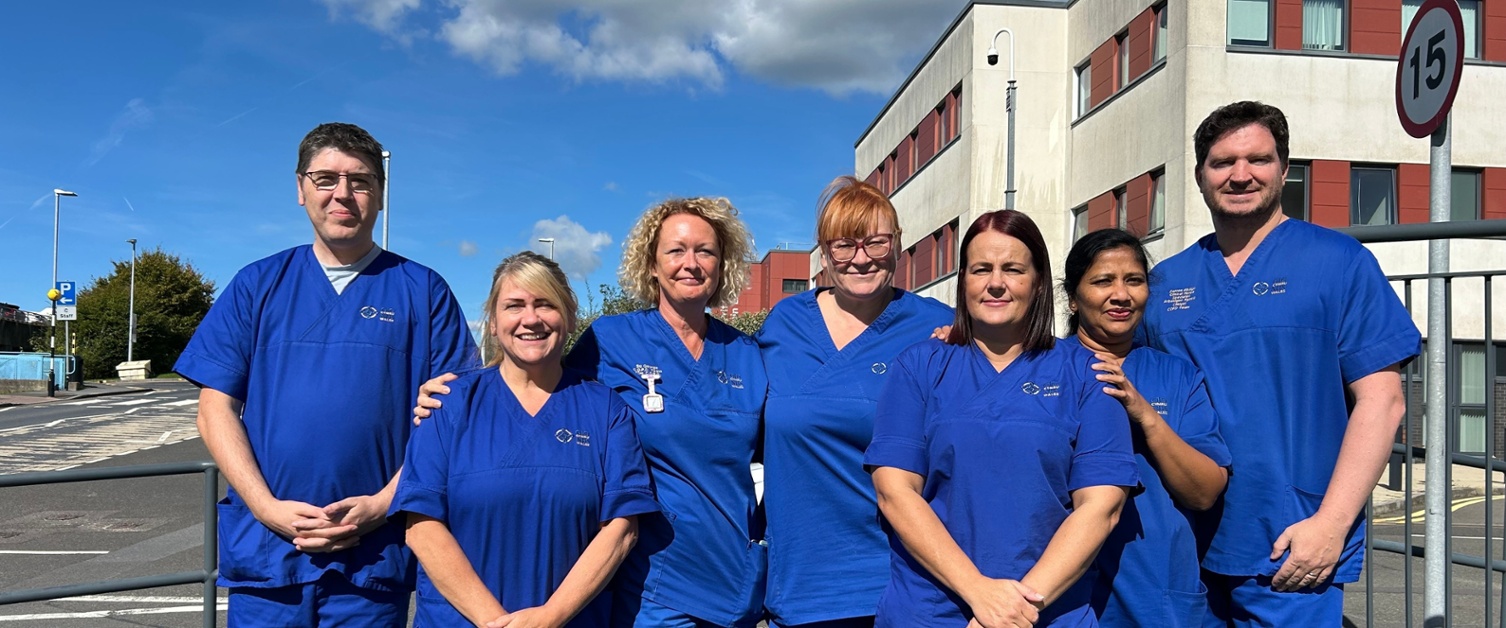
Pictured (l-r): Community staff nurse David Nicol and clinical nurse specialists Sharon Davies, Susan George, Sarah Jones, Louise Jenkins, Jolly Thomas and Darren Phillips.
Rydym yn croesawu gohebiaeth a galwadau ffôn yn y Gymraeg neu'r Saesneg. Atebir gohebiaeth Gymraeg yn y Gymraeg, ac ni fydd hyn yn arwain at oedi. Mae’r dudalen hon ar gael yn Gymraeg drwy bwyso’r botwm ar y dde ar frig y dudalen.
We welcome correspondence and telephone calls in Welsh or English. Welsh language correspondence will be replied to in Welsh, and this will not lead to a delay. This page is available in Welsh by clicking ‘Cymraeg’ at the top right of this page.