Award-winning pressure ulcer service celebrated internationally on its 20th anniversary
An award-winning service which helps patients with complex pressure ulcers has been recognised across Europe as it celebrates its 20th anniversary.
A pressure ulcer, previously known as a bed sore, is damage to the skin and underlying tissues caused by remaining in one position for too long. They can be devastating for patients and their families, having a serious negative impact on quality of life, not just physically but emotionally, socially and financially.
Swansea Bay University Health Board’s Pressure Ulcer Prevention and Intervention Service (PUPIS) was launched in 2005. It followed a research project aligning nurse specialists with rehabilitation engineers with expertise in pressure relieving surfaces and postural management.
Now, as the PUPIS team mark their 20th year, their work has been presented at a prestigious European conference, and has also been held up as an exemplar by another European organisation.
PUPIS has highlighted the direct link between posture and pressure ulcers, and also the benefits of patient engagement, education and self-care.
It was founded from a collaboration with the Welsh Centre for Burns and Plastic Surgery where a streamlined pathway for pressure ulcer reconstructive surgery was developed.
Susan Flavin, PUPIS Clinical Nurse Specialist, said: “Central to our service is patient-centred care, understanding their psychological, social and physical needs.
“Education is critical, ensuring patients and carers understand how pressure ulcers form, how to offload them and how to avoid them reoccurring.
“In support of self-care we take time to listen to their specific challenges, ensure they feel informed and empowered, and respect them in their daily balance to manage risk.
“It’s not just about healing wounds but enabling quality of life and independence. Sometimes the goal is simply to get someone out of bed safely so they can function and interact more fully with all the health benefits that brings.”
The team supports patient self-management of pressure risk, to prevent and stop recurrence, and provides pressure relief and postural support. They also use technologies such as interface pressure mapping, to identify the contributory risk factors and develop interventions and education – all individually tailored to each patient’s needs.
Pressure mapping also gives patients a unique insight to what pressure looks like and what pressure relieving exercises work best for them. Bespoke training and an open-access pressure mapping clinic are now offered to those with spinal cord injuries.
Dr Mark Bowtell, Principal Clinical Scientist and Deputy Head of Rehabilitation Engineering said: “PUPIS is constantly innovating, adapting to patient needs and new technology, whether it’s streamlining the referral process, or altering service models.
“For example - we wanted to provide professionals with simplified, but high impact, information at their fingertips during patient interactions, so we developed an app called ‘Offload’ which is available on iPads.
“The goal was to present solutions for the complex problem of pressure ulcer prevention, in a non-complex way.”
Susan added: “It is important we support and empower our colleagues in the commun9ity to manage more complex patients. We realised we were facing a lot of the same problems that were actually in the hands of the patient and the local care team to resolve.”
The team has developed training sessions for district nurses, therapists, care home staff and other professionals to come together to learn and discuss pressure ulcer prevention and management planning. The emphasis is around techniques to reduce pressure through increasing activity, and the importance of posture.
PUPIS is also creating a series of “how to” guides to aid local mamage3ment of common risk areas, such as the feet, pelvis and spine, as well as a guide to managing skin integrity in those contractures.
Close working with the plastic surgery team has not only reduced the time patients spend in hospital - reducing inpatient bed days from 49 days to an average of 28 days - but it’s also made a significant difference to how their care is managed.
The PUPIS nurse specialist will see patients to consider surgery and carry out a clinical assessment ensuring their pressure management, general health and wellbeing is optimised. Many do not need a review by the plastic surgeon, but a small number do go on to be considered for reconstructive surgery.
For those who do need surgery, prehabilitation is offered to build up their strength and independence ahead of their operation. This optimises their surgical outcome and speed of rehabilitation, and reduces the risk of the pressure ulcer coming back.
Reconstructive surgery comes with high risks and requires coordination between multiple specialities. Susan recently initiated a multi-disciplinary team (PU MDT) which included plastic and orthopaedic surgeons alongside radiology and microbiology to plan for these complex cases.
She added: “Having the expertise of this multi-disciplinary team has made a huge difference. The members are experts in their field. Their commitment and dedication are having a profound effect on the patients care and outcomes.“
Susan recently presented on the development and success of PUPIS at the European Wound Management Association conference and has since been approached by a plastic surgery department in Denmark to share the work done in Wales.
The service was also picked out as an exemplar service within a review of service models for pressure ulcer reconstruction at the European Pressure Ulcer Advisory Panel (EPUAP) conference.
To mark 20 years of PUPIS, the team has also captured feedback from related services. The team were overwhelmed by the responses, including the following:
- “We are very lucky in Wales to have such a unique service that compliments and elevates the care and support we can give to individuals with or at risk of pressure damage and people caring from them. Thank you PUPIS, and long may you be there to support us all and continue make a positive difference to patient outcomes”
- “An invaluable service with regards to patient wellbeing and management of pressure areas”
- When we make a referral we receive prompt and excellent support on every occasion and follow up care, support and advice”
The PUPIS service is accessed through community nursing, nursing care homes and schools for complex pupils, where more specialised intervention is needed.
More about pressure ulcers
Starting with reddening of the skin, if they are not offloaded, damage can be extensive, affecting deeper layers of skin or muscle and bone.
PUPIS is part of the Rehabilitation Engineering Unit, based at Morriston Hospital, and sit under the department of Medical Physics and Clinical Engineering.
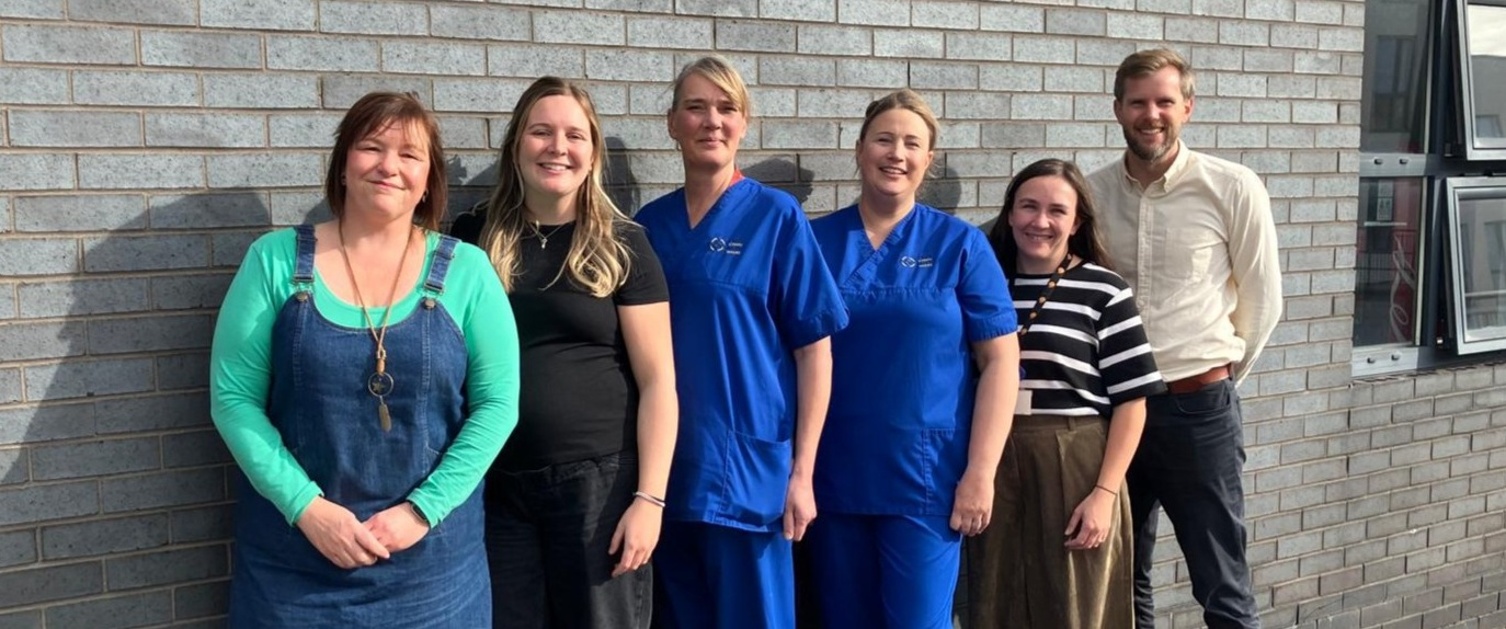
Pictured: PUPIS team members Cathryn Simons, Pearl Read, Susan Flavin, Rebecca Darby, Kelly Jones, Mark Bowtell.
Rydym yn croesawu gohebiaeth a galwadau ffôn yn y Gymraeg neu'r Saesneg. Atebir gohebiaeth Gymraeg yn y Gymraeg, ac ni fydd hyn yn arwain at oedi. Mae’r dudalen hon ar gael yn Gymraeg drwy bwyso’r botwm ar y dde ar frig y dudalen.
We welcome correspondence and telephone calls in Welsh or English. Welsh language correspondence will be replied to in Welsh, and this will not lead to a delay. This page is available in Welsh by clicking ‘Cymraeg’ at the top right of this page.