Pelvic Floor Dysfunction
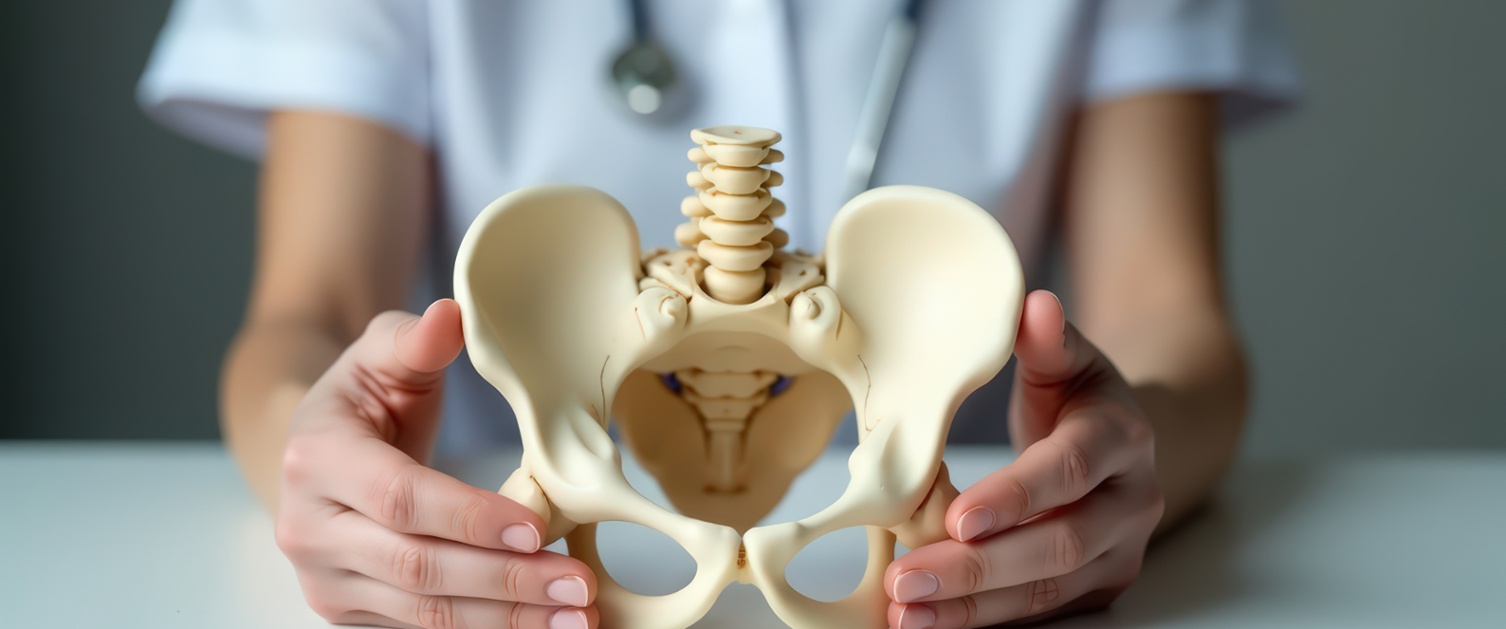
Pelvic floor dysfunction is common amongst women and can lead to a variety of symptoms.
Examples of pelvic floor dysfunction include:
- Urinary frequency and urgency (needing to pass urine more often and rushing to pass urine)
- Urinary incontinence (bladder leaks)
- Pelvic organ prolapse
- Bowel incontinence (bowel leakage)
Below is further information and resources to help you find ways of managing some of your symptoms.
The pelvic floor muscles are a group of muscles that span the underside of your pelvis, forming the ‘floor’ of your pelvis. They insert into the pubic bone at the front, they fan out to the side into your sitting bones, and then into your tailbone/coccyx at the back.
The pelvic floor muscles support the bladder, reproductive organs, and bowels inside the pelvis, keep us continent of urine and faeces, provides stability to the spine and pelvis when we are active, and have an important role in sexual function.
The muscles can become dysfunctional (not work properly), this can be due to a number of factors including pregnancy and delivery, age, menopause, chronic choughs, chronic constipation. Typically, we think of pelvic floor muscles becoming weaker, with a reduction in endurance and function. This leads to symptoms such as urinary incontinence, pelvic organ prolapse and problems with bowel control.
If you think your muscles are weak follow the advice below.
How to find and exercise your pelvic floor muscles:
- Lie down or sit upright, in a comfortable position.
- Imagine that you are stopping yourself from passing wind and then stopping the flow of urine.
- It should feel like a squeeze and lift up of the pelvic floor muscles from the back passage towards the bladder.
- Continue to breathe normally, don’t hold your breath or squeeze your buttocks or leg muscles, and ensure you fully relax after every squeeze.
Other cues that can help engage your pelvic floor muscle include:
- Squeezing your pubic bone and your tail bone together
- Pretending you have a tail and curling it between your legs
- Imagine you are sucking up a marble with your back passage
How often should we do them?
- Long squeezes - tighten up your pelvic floor muscles, hold the squeeze, then release/relax them fully. How long can you hold it for?
Repeat the long squeezes until the muscles fatigue. How many times can you repeat it?
Aim eventually to do 10 second holds and repeat 10 times
- Short Squeezes – quickly tighten up your pelvic floor muscles, then immediately release/relax them fully. How many times can you do this before the muscles fatigue?
Aim eventually to do these 10 times
- Repeat these exercises 3 times each day and try to do them in lie, sit or stand. Sitting or lying down will be easier to start with
- It is important to fully release/relax in between each squeeze. The aim is to have strong muscles that can fully lengthen too. ‘Pulsing’ your muscles could shorten them.
-
You may find it easier to start the exercises in lying or sitting but it is important to progress these to standing or functional positions where you feel you need more support from your pelvic floor muscles.
Pelvic Floor Muscles and Breathing
It can be important to link your pelvic floor with your breath and having good breathing technique is important.
Very often, in day to day life we breathe shallowly mostly using our upper chest, rather than focusing on using our diaphragm.
Sit or lie comfortably with one hand lightly on your upper chest and one hand on your upper abdomen (tummy or belly), where it meets your lower ribs. Focus your attention on your breathing.
If comfortable for you, breathe in slowly through your nose, and then out through either your nose or mouth.
Aim to keep your upper chest more relaxed as you breathe in and out. You may need to adjust your position or posture so that the bottom of your ribcage can move freely. If you are slouched then the ribcage may be restricted.
Try imagining that you have a balloon in your abdomen and as you breathe in, the balloon is gently inflating with the breath. This should cause your tummy to gently rise, and your lower ribs to lift outwards. As you breathe out, imagine the balloon gently deflating – your abdomen should gently fall.
To link this with your pelvic floor exercises as you breathe out lift and squeeze your pelvic floor muscles holding as you take a few gentle breaths.
A normal bladder:
-
Will empty every 3-4 hours
-
Can hold about 400mls of urine comfortably
-
May wake you up once a night
-
Give you enough warning to get to the toilet
-
Empty completely each time you pass urine
-
Will not leak
A normal bowel:
-
Produces a soft, formed easy to pass motion
-
Can work up to three times per day but no less than three times per week
-
Does not require you to strain
To keep the bladder and bowel healthy you should:
-
Drink at least 8-10 cups of fluid per day, including 5 glasses of water. This will help to keep your kidney healthy. Cutting down will make things worse.
-
Try cutting down on caffeine (found in tea, coffee, cola). Try brands without caffeine
-
To help prevent urinary tract infections try drinking cranberry juice. (Patients on Warfarin should not drink cranberry juice)
-
Perform pelvic floor exercises
-
Avoid constipation. Eat plenty of fruit and vegetables. Visit the dentist if you cannot chew properly
-
Pass urine only when you need to, never go “just in case."
-
Keep as active and as mobile as you can
-
Try not to become overweight, this will cause extra strain on your pelvic floor
-
Make sure you are able to reach the toilet with ease and that your clothes are adjustable
Bladder training
The aim of bladder training is to re-establish normal control of the bladder. Provided you do the exercises with determination you should see a significant improvement.
Firstly complete the 3 day frequency/voiding chart provided. This will show how often you pass urine, and the amount. You should also record the type of fluid you drink and how much.
The training programme requires you to gradually increase the time interval between passing urine.
Gradually you should hold on longer and longer especially in the day.
Most people who start bladder training find it hard at first, and you may find you leak slightly more for a short time, but you will usually start to see an improvement within weeks.
Bladder urge suppression techniques
The following may be useful to help to suppress the urge to pass urine:
- Remove any stimulus that may increase the problem e.g. tap dripping
- Stop what you are doing and cross legs, avoid rushing to toilet in mid urge
- Perform a pelvic floor exercise
- Walking on toes or change position, relaxed breathing
- Distraction
- Avoid panicking and stay calm for a couple of minutes
- Sit down and press the spine against the back of the chair
Pelvic floor exercises
How should I do pelvic floor exercises?
Choose any comfortable position, with your knees slightly apart. Now imagine that you are trying to stop yourself from passing wind and at the same time trying to stop your flow of urine. The feeling is one of ‘squeeze and lift’, closing and drawing-up the back and front passages. Do these two together and you should be exercising your pelvic floor muscles.
The Pelvic Floor Exercise Programme
When you have learned the exercises try to perform them slow and fast.
Slow exercises
Gradually tighten the muscles and hold for as many seconds as indicated by your health professional, eventually aiming to count up to 10. This helps the muscles provide support for your bladder and bowel.
Fast exercises
Tighten and relax the muscles quickly. This helps the muscles to stop the urine leaking when you sneeze, laugh or exercise.
The quality of the contractions are more important than the quantity you do.
Fewer good exercises are better than many half hearted ones!
Build up to doing 10 slow exercises and 10 fast exercises four times each day. It really is worth the effort! Progress will be slow before you notice improvements, but don’t give up.
If you do the exercises regularly and correctly you will start to see improvements within a few months. Remember you need to continue the exercises for life.
For further advice please contact your local Continence Advisor between 9am and 4pm (an answer phone service is available on each number, but messages may not be answered on the day that they are left).
Community Services: 01792 532424
Singleton Hospital: 01792 285384
Morriston/ NPT Hospital: 01792 703092
Urinary incontinence is a common condition affecting 1 in 3 women. However, it should not be accepted as the norm and can improve with simple advice and exercises found below.
There are two main types of urinary incontinence:
- Stress incontinence. Follow this link to find more information about stress incontinence.
- Urge incontinence. Follow this link to find more information about urge incontinence.
Stress and urge incontinence can also occur together and this is known as mixed incontinence.
Bladder Frequency, urgency and urge incontinence may be due to an overactive bladder.
If you are experiencing stress incontinence and/or urge incontinence strengthening your pelvic floor muscles can help to improve your symptoms – see the Pelvic floor exercises section for more information on this.
Follow this link to find more information about overactive bladder syndrome.
Healthy bladder habits
You may want to avoid drinks that can irritate the bladder if you experience urinary frequency, urgency or urge incontinence.
Follow this link to find more information on healthy bladder advice.
Bladder training
Bladder training can often help to reduce frequency, urgency and urge incontinence.
If you have difficulty fully emptying your bladder, watch the video on the link below for helpful techniques.
Follow this link to YouTube where you can watch a video on emptying your bladder.
Pelvic floor dysfunction
Pelvic floor dysfunction can contribute to difficulties emptying the bladder. This can be due to either a weak or a tense pelvic floor. Assessment by a pelvic health physiotherapist will be able to guide you on whether your pelvic floor muscle needs strengthening or releasing if the above hasn't worked.
Bladder investigations
You may have been referred for investigations by your Consultant, Urology Nurse or Bladder and Bowel Nurse.
Healthy bowel
Healthy bowel habits are important as straining to empty your bowels can make urinary incontinence worse, see the healthy bowel section for more advice.
Menopausal symptoms
Menopausal symptoms can influence pelvic floor dysfunction symptoms. See the menopause section for some useful information regarding the menopause.
Healthy bowels should empty anything between three times per day and three times per week.
A stool (poo) should be easily passed without straining, pain, or blood.
It is important to avoid constipation and straining to empty your bowels as this can contribute to pelvic floor dysfunction.
- Adjusting your position on the toilet
- Drinking enough fluids
- Eating plenty of fibre
All of the above can help, along with taking any medication prescribed for you. If you have difficulty emptying your bowels the section below has more information on this.
Bowel control problems can affect people in different ways:
- Sudden urges to poo that you can’t control
- Accidental bowel leakage
- Being unable to hold on to wind
Follow this link to the NHS website to find information about bowel incontinence.
Follow this link to find more information about improving your bowel function.
Follow this link to find information about faecal incontinence.
Your pelvic floor muscles are responsible for controlling both your bladder and your bowels. Improving your pelvic floor strength can help to manage these symptoms. See the pelvic floor exercise section for further information on this.
Menopausal symptoms can influence pelvic floor dysfunction symptoms. See the menopause section for some useful information regarding the menopause.
Constipation refers to infrequency or difficulty opening your bowels, where stools may be hard, lumpy or painful to pass.
Follow this link to the NHS website where you can find information about constipation.
Follow this link to the Guts UK website where you can find information about constipation.
Follow this link to the Association of UK Dietitians website to read about fibre.
Follow this link to find more information about improving your bowel function.
It is important that you regularly check your stools to rule out more serious conditions that can affect bowel function.
Adapting the position you use to sit on the toilet can help ‘straighten out’ the back passage, which makes it easier to pass stools.
The following videos may be useful:
Follow this link to YouTube to watch a video of how to avoid straining when going to the toilet.
Follow this link to YouTube to watch a video of how to open your bowels without straining.
Follow this link to YouTube to watch a video of an abdominal massage.
It is also important to ensure you fully relax the pelvic floor when passing a stool, difficulty relaxing the pelvic floor can also contribute to problems with emptying.
Pelvic floor dysfunction can contribute to difficulties emptying the bowels. This can be due to either a weak or a tense pelvic floor. Assessment by a pelvic health physiotherapist will be able to guide you on whether your pelvic floor muscle needs strengthening or releasing if the above hasn't worked.
Menopausal symptoms can influence pelvic floor dysfunction symptoms. See the menopause section for some useful information regarding the menopause.
The organs within a woman’s pelvis (uterus, bladder and rectum) are normally held in place by ligaments and muscles. If these support structures are weakened, the pelvic organs can bulge (prolapse) from their natural position into the vagina. When this happens it is known as pelvic organ prolapse. Sometimes a prolapse may be large enough to protrude outside the vagina.
Strengthening weak pelvic floor muscles can help to prevent or reduce pelvic organ prolapse symptoms. They can be strengthened by doing regular pelvic floor muscle exercises. See the pelvic floor exercise section for further information on this.
Follow this link to find information about using a pessary to manage prolapse symptoms.
Healthy bowel habits are important as straining to empty your bowels can make prolapse symptoms worse, see the healthy bowel section for more advice.
Some women find it helps to support the perineum (the area between the vagina and back passage) with a clean pad or toilet paper.
Menopausal symptoms can influence pelvic floor dysfunction symptoms. See the menopause section for some useful information regarding the menopause.
Pain during and/or after sex is known as dyspareunia. Follow this link to read more about dyspareunia.
There are many causes of dyspareunia. Some women have tension in their pelvic floor muscles (sometimes known as an overactive or tight pelvic floor) and this may contribute to pain having sex.
Below are some links to information you may find useful:
Follow this link to YouTube to watch a video on pelvic floor release stretches.
Follow this link to YouTube to watch a video on how to release pelvic floor tension.
Follow this link to YouTube to watch a guided meditation for pelvic floor relaxation.
Follow this link to YouTube to watch a video on the top three pelvic floor stretches.
Vaginal dryness can be a cause of pain during intercourse. If you haven’t already, trying a natural lubricant can sometimes reduce this discomfort. There are a number of different types of lubricant including water based, oil based and silicone based. Please check the manufacturers instructions as some lubrications are not compatible with latex, silicone and other products. If you have tried these and are still having pain with intercourse, this is something Physiotherapy may be able to support you with.
We see many women who have been referred to physiotherapy due to symptoms of persistent (also known as chronic) pelvic pain. These can include bladder pain syndrome (interstitial cystitis), chronic pelvic pain and vulvodynia.
Follow this link to read more about bladder pain syndrome.
Follow this link to find more information on interstitial cystitis.
Follow this link to read more about chronic pelvic pain.
Follow this link to find more information about vulvodynia.
Below you can find some useful information that you may find helpful if you have a persistent pain condition:
Follow this link to YouTube to watch a video about understanding pain.
Follow this link to find more information about understanding your persistent pain.
Follow this link to find more information about managing your pain.
You can find more helpful information and videos below:
Follow this link to YouTube to watch a video on pelvic floor release stretches.
Follow this link to YouTube to watch a video on how to release pelvic floor tension.
Follow this link to YouTube to watch a guided meditation for pelvic floor relaxation.
Follow this link to YouTube to watch a video on the top three pelvic floor stretches.
If you have endometriosis, you can find some helpful information below:
Follow this link to the Endometriosis Cymru website to find more information.
Follow this link to the Endometriosis UK website where you can find more information.
Vaginismus is when the vagina suddenly tightens when trying to insert something in to it. Penetration of any kind may be difficult, painful or impossible. The term vaginismus refers to an involuntary contraction or spasm of the pelvic floor muscles surrounding the entrance to the vagina in response to attempted penetration. It is characterized by intense fear or anxiety related to vaginal penetration or intercourse.
Vaginismus doesn’t necessarily affect your ability to get aroused or enjoy sexual activity other than penetration.
Primary Vaginismus: This refers to a situation in which no form of vaginal penetration has ever been possible. It may be detected when first trying to use tampons, or first having penetrative sex.
Secondary Vaginismus: This refers to a situation in which pain-free penetration has been achieved previously and refers to a development of vaginismus symptoms at a later date.
Signs of Vaginismus can include:
- Difficulty inserting a tampon
- Burning or stinging pain with vaginal penetration
- Difficulty achieving vaginal penetration
- Feeling that there is a block preventing vaginal penetration
- Discomfort and difficulty when having a vaginal examination or smear test
- Anxiety around penetrative sex/vaginal penetration
What causes Vaginismus?
The causes of vaginismus are not always obvious. There can be a mixture of biological, social, cultural and psychological factors involved, for example:
- An underlying physical condition, such as thrush or a skin condition, may trigger pain during sex and over time this might lead to the development of vaginismus.
- Beliefs, anxieties or fears surrounding sex may play a part. A fear of penetration, a belief that it will be painful, or a fear of sexually transmitted infection, or pregnancy, may lead to vaginismus symptoms.
- Some women may develop vaginismus as a result of a negative experience, for example sexual assault, unwanted sex, or a bad/painful experience during a medical examination.
- Some social and cultural messages about penetrative sex may also contribute to the development of vaginismus.
It isn’t always completely clear-cut and you may not be able to identify the exact cause of your symptoms.
Symptoms of vaginismus can persist for a significant length of time if not treated, even if you actively wish to engage in penetrative activities and even if you had an infection that has now resolved. The muscle spasms are an involuntary reflex response aimed at protecting you from anticipated discomfort - they are not under your conscious control.
Any form of anxiety around penetration can cause the pelvic floor muscles to contract and tighten, making penetration more difficult and in some cases uncomfortable or impossible. This can become a vicious circle in which you anticipate discomfort and your pelvic floor muscles respond by tightening and preventing penetration.
Can Vaginismus be treated?
Yes – vaginismus can be treated. If you think you may have vaginismus you should visit your GP. They may need to do a vaginal examination to rule out infection or any other contributing factors. Depending on the likely causes of your symptoms, your GP may refer you for pelvic health physiotherapy and/or psychosexual therapy. Both of these can help with your symptoms.
How is Vaginismus treated?
Treatment usually focuses on managing your feelings around vaginal penetration and exercises to gradually get you used to vaginal penetration.
Treatments may include:
- Mindfulness, breathing techniques, and gentle touch exercises to help you relax your pelvic floor muscles
- Practising techniques that help to release tension in the pelvic floor muscles – see the Pain with Sexual Intercourse section of this website for more information on this.
- Sensate focus – progressive exercises you can work on with your partner to help you relax during sexual activity
- Vaginal trainers – smooth, tampon-shaped devices, of progressively increasing size, that you insert in to your vagina, completely within your comfort level
- Psychosexual therapy – talking therapy that can help you understand and manage your feelings and thoughts about your body and sex
What can I do to help ease my symptoms?
It is a good idea to stop the activity that is triggering the vaginismus until you have undergone a course of treatment. Continuing to try to have penetrative sex or use tampons for example, when experiencing vaginismus, can exacerbate the symptoms and be detrimental to your progress.
Follow this link to the NHS website where you can find more information on vaginismus.
Follow this link to the Melo Mindfulness website where you can access support.
Rydym yn croesawu gohebiaeth a galwadau ffôn yn y Gymraeg neu'r Saesneg. Atebir gohebiaeth Gymraeg yn y Gymraeg, ac ni fydd hyn yn arwain at oedi. Mae’r dudalen hon ar gael yn Gymraeg drwy bwyso’r botwm ar y dde ar frig y dudalen.
We welcome correspondence and telephone calls in Welsh or English. Welsh language correspondence will be replied to in Welsh, and this will not lead to a delay. This page is available in Welsh by clicking ‘Cymraeg’ at the top right of this page.