Respiratory nurses saving lives on the home front
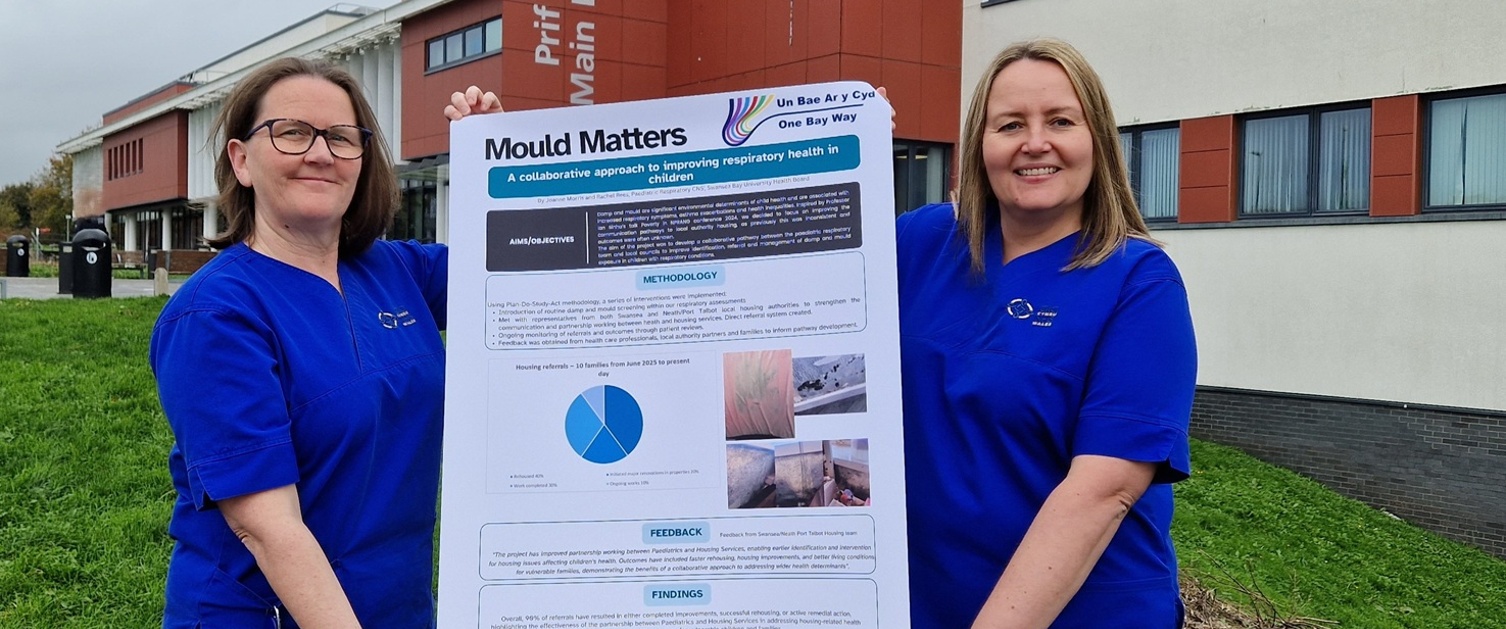
Two Swansea Bay paediatric nurses are helping save children’s lives through highlighting poor living conditions which exacerbate respiratory diseases.
When Joanne Morris and Rachel Rees looked into the home background of many of their young respiratory patients, a common pattern of poverty and depravation arose.
Such conditions can see black mould appear on walls, which can dangerously inflame conditions such as asthma and cystic fibrosis, lethally so in some cases.
Rochdale toddler Awaab Ishak died in 2020 from a respiratory condition caused by prolonged exposure to mould in his social housing home. This led to Awaab’s Law being introduced in England, requiring social landlords to investigate and fix damp, mould, and other serious hazards within strict deadlines.
Aware of the law, Joanne and Rachel set about collaborating with Swansea and Neath Port Talbot councils and the various social housing organisations within the region, to pass on their concerns when they came across poor living conditions. They also encourage parents to report any concerns to their landlords.
The pair first became aware of how crucial living conditions can be in determining children’s health following a conference in 2024. Joanne said: “We were motivated by a well-known doctor, Dr Ian Sinha, who does a lot on poverty and respiratory conditions in children.
“He delivered a really inspirational talk about the effects of mould on maturing children's lungs. Such situations can lead to death.
“We know from our practice that this is a big issue that comes up a lot in clinic.
“We decided to develop collaborative working, with our local authorities and social housing providers. We now have a direct line with them to highlight the children who are frequently attending our wards and who we are seeing in clinic.
“There's a housing crisis, and there's a real problem, trying to identify those people who really need rehousing.”
Pictured above: Rachel and Joanne with their poster
The pair set about raising awareness of the dangers involved and highlighted the introduction of Awaab’s Law.
Rachel said: “Awaab’s death was directly attributed to exposure to black mould and damp within that house. Unfortunately, even though his parents had tried to address the situation with social housing, it was overlooked and this contributed to his death. He was only two.
“It's something we all have to be aware of, and as part of that, we thought we need to have something in place that's able to help these families.”
Their cause is all the more timely with the cost of living crisis making the situation worse.
Joanne said: “It's definitely more common than years ago, and it probably has to do with poverty. It's people not being able to put on their heating when they want to put it on and other similar things.
“We know that exposure to damp and mould will harm immature lungs and obviously lungs that are diseased, such as asthma. We know it all contributes to poor outcomes.
“If they have asthma, living in a house with mould can exacerbate the symptoms. We look at the symptoms and we optimise our medications. But it doesn't matter what medications they're given, if they are living in a place like that. It's like they're living with somebody that's smoking next to them. We have to address it.
“They have to report it, get it reviewed by the council as soon as possible to start work. This is very dangerous for immature developing lungs and they need to get it seen to.”
Fortunately, their awareness campaign appears to be working.
Joanne said: “We've had success with those that have been rehoused. They're not coming to hospital anymore, due to the removal of the triggers.”
Central to their awareness campaign Joanne and Rachel developed a poster based on tackling mould in the community. They took a collaborative approach involving local councils to ensure that children with respiratory issues are given priority in damp-proofing measures or rehousing, leading to improvement in their respiratory issues.
Their poster has since won a national award and the pair will present it in the National Paediatric Respiratory and Allergy Nurses Group’s annual conference next month.
Consultant paediatrician and Swansea Bay’s respiratory lead Huma Mazhar said: “On behalf of the respiratory team, I would like to commend Joanne and Rachel’s outstanding efforts in advocating for children whose asthma control was adversely affected by damp and mould in their homes.
“These conditions can trigger and worsen asthma symptoms, contributing to persistent cough, wheeze, disturbed sleep and recurrent exacerbations, and making good asthma control difficult despite appropriate treatment.
“Recognising the importance of addressing these environmental factors, Joanne and Rachel proactively contacted the council to arrange property inspections and supported families in securing better housing.
“Their work has helped children move into healthier living conditions, contributing to improved asthma control and respiratory health. Their initiative, compassion and commitment demonstrate the vital role of specialist nursing in addressing the wider determinants of health and achieving meaningful improvements for children and their families.”
Social housing tenants can report any concerns to:
Swansea Social housing: HousingRepairs.CallCentre@swansea.gov.uk
Neath Port Talbot Social Housing: Problem with a rented property - NPT Council Environmental Health.
Rydym yn croesawu gohebiaeth a galwadau ffôn yn y Gymraeg neu'r Saesneg. Atebir gohebiaeth Gymraeg yn y Gymraeg, ac ni fydd hyn yn arwain at oedi. Mae’r dudalen hon ar gael yn Gymraeg drwy bwyso’r botwm ar y dde ar frig y dudalen.
We welcome correspondence and telephone calls in Welsh or English. Welsh language correspondence will be replied to in Welsh, and this will not lead to a delay. This page is available in Welsh by clicking ‘Cymraeg’ at the top right of this page.