'Modern-day miracle' patient Leighton thanks life-saving staff
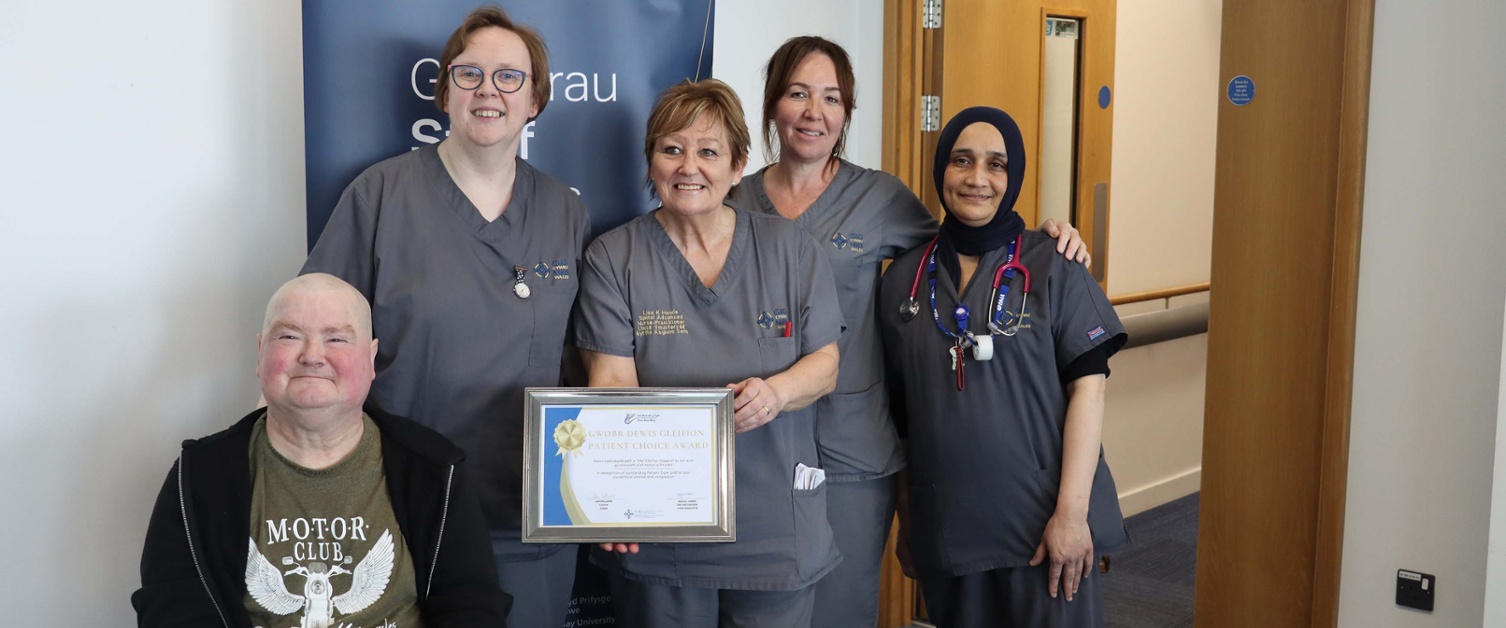
A man who was so unwell that his family said their goodbyes has returned to the hospital that saved his life twice in two years to thank staff.
Leighton Davies and wife Melanie were at Morriston Hospital in Swansea as some of the dozens of clinicians and microbiology staff involved in Leighton’s diagnosis and care received Patient Choice Awards following the couple’s nomination.
“It’s thanks to the care of all these people that he is alive. It’s unbelievable,” said Melanie.
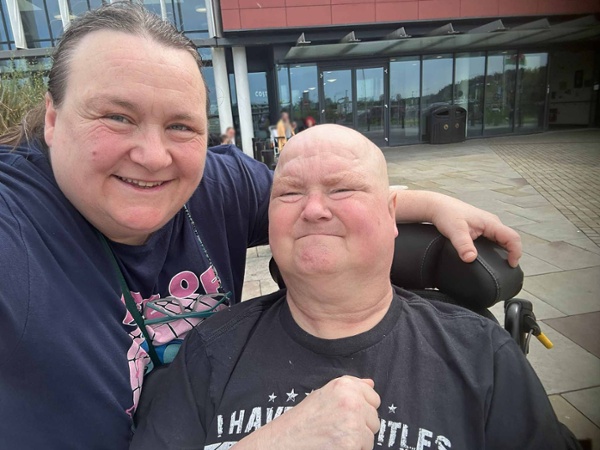 Leighton Davies and wife Melanie pictured outside Morriston Hospital
Credit: SBUHB
“They have all been brilliant and still are brilliant,” said Leighton, 56, from Cwmavon, Port Talbot.
Leighton Davies and wife Melanie pictured outside Morriston Hospital
Credit: SBUHB
“They have all been brilliant and still are brilliant,” said Leighton, 56, from Cwmavon, Port Talbot.
Recalling the months spent in hospital, he added: “It didn’t feel like it was a job to them. It felt like they were caring for a friend or family member.
“And today I felt like a celebrity with all the love I had from the staff. It has really perked me up. I’m just glad to be here.”
Leighton is currently working hard to regain his mobility after complications from Covid, bacterial meningitis and other health issues that threatened his life between 2023 and 2025.
He used his first trip out of the house in the car to attend the awards.
Separate presentations saw the Infectious Diseases Team, including virology and bacteriology team members from Public Health Wales Microbiology Swansea, and the MSK Spinal Team given awards.
Other teams, including wards, and individuals nominated by the couple, have received their awards at separate events.
Leighton’s return to Morriston was a full circle moment for staff who had seen him at his lowest point.
Rhiannon Hawes, Spinal Advanced Nurse Practitioner, who picked up the award on behalf of the entire MSK Spinal Team, said: “It is amazing to see Leighton now. He’s like a different person.”
Grandad-of-five Leighton had been coping with heart failure, rheumatoid arthritis and a condition called spinal stenosis - a narrowing of the tunnel in the spine which presses on the nerves causing pain and weakness in the legs - when he became very unwell in the autumn of 2023.
The medication he’s prescribed for rheumatoid arthritis suppresses his immune system and makes him susceptible to infection. He deteriorated at this time.
“He wasn’t getting any better,” said Melanie, 52.
Following his admission to ward J, staff broke the news that he had Covid and was struggling to breathe. They feared he would not survive.
“I was told to call the family. They were moving him to palliative care,” said Melanie.
“Our daughters came over and said their goodbyes on the Monday. That day he was on the highest amount of oxygen.”
But, as Melanie explained in the award nomination, a number of staff including the Infectious Diseases Team and Critical Care Outreach Team “left no stone unturned” and tried everything they could to save him.
It resulted in what she believes was “a modern-day miracle”, with Leighton sat up in bed “eating, drinking and joking” by the Friday.
“Everybody came to see because they couldn’t believe what had happened,” she said.
Consultant in Microbiology and Infectious Diseases for Public Health Wales, Brendan Healy, said the infectious disease team treated Leighton with a combination of treatments. He explained the diagnosis of Covid, made by virology lab staff, was the crucial first step to Leighton’s survival.
He said: “We can be confident that the Covid diagnosis made a huge difference in his case because it enabled us to target both the virus and his immune response to the virus and it is without question that one of these two treatment options resulted in his recovery.”
Despite coping with the lasting effects of pulmonary fibrosis, scarring of the lung tissue which was attributed to Covid, Leighton was able to return to normal life.
Then in early 2025 he went into another hospital for spinal surgery.
The operation went well and despite some issues he returned home a few weeks later.
“Then I woke up one morning and Leighton was unresponsive in bed next to me,” said Melanie.
Rushed to Morriston Hospital once more, it was found he had meningitis caused by the Klebsiella bacteria.
Desperately unwell and vulnerable, Leighton also suffered kidney failure, signs of a cardiac arrest known as a peri arrest, sepsis, another bout of Covid and further issues with an unstable spine which required spinal surgery, in the weeks that followed.
But, once again, a legion of staff supported Leighton including those in Public Health Wales Microbiology, Infectious Diseases, the Intensive Care Unit, the Critical Care Outreach Team, Spinal Team, staff on wards G and H and physiotherapists.
“Everyone kept fighting and so did we,” said Melanie.
Dr Healy said bacteriology lab staff identified a particularly resistant strain of Klebsiella and their work enabled clinicians to use treatments, including new antibiotics, active against this bacteria.
He added: “The work in the lab was critical in enabling the clinical staff to prescribe the correct treatments and it was great to see the lab staff receiving some recognition for their contribution to Leighton’s survival.”
A brief return to hospital in September 2025 for treatment for diverticulitis saw Leighton treated on ward V.
He has since been recovering at home with help from a physiotherapist.
And in March the couple, who have three grown-up children, welcomed their fifth grandchild Betty, who, along with Kane, 10, Blake, seven, Maddie, six, and James, four, motivate Leighton to continue with his rehabilitation journey despite its many challenges.
“All the grandchildren call him Grumpy, except James who calls him Papa,” said Melanie.
“As Leighton has spent so much time in bed, he’s taken up Lego as a hobby and Blake loves doing that with him.”
Recognising that things could have been very different for their family, Melanie said staff deserve proper recognition and not just for how they cared for Leighton, but also for how they cared for her.
“The sisters supported me as well as Leighton,” said Melanie, who would spend up to 18 hours a day in hospital with her husband for months at a time.
“They would make sure I could use the shower when it was quiet at night and made sure I was eating and drinking. It was beyond what you would believe from a hospital.
“And I have seen the staff go through so much themselves, but it never affected the way they worked.”
Describing how hospital staff have become more like family over time, Melanie added: “Even now staff, including the healthcare support workers, message us to ask how he’s doing.”
- The Patient Choice Awards are an annual feature of Swansea Bay University Health Board’s staff recognition programme and are awarded directly as a result of patient and family nominations. This time more than 500 nominations were received with hundreds of awards handed out across more than a dozen events.
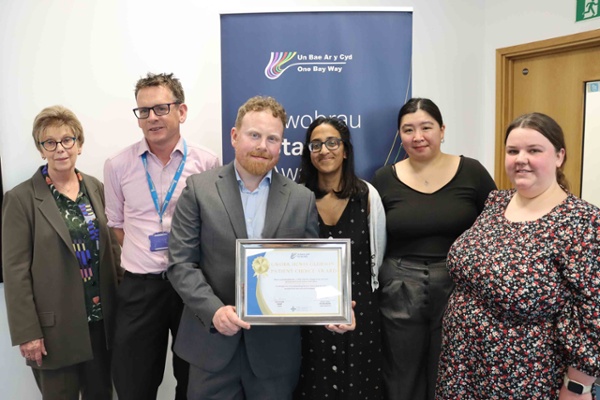 Health Board Chair Jan Williams, far left, presented Dr Brendan Healy, second from left, and other Public Health Wales clinicians and laboratory staff with their Patient Choice Award
Credit: SBUHB
Health Board Chair Jan Williams, far left, presented Dr Brendan Healy, second from left, and other Public Health Wales clinicians and laboratory staff with their Patient Choice Award
Credit: SBUHB
Rydym yn croesawu gohebiaeth a galwadau ffôn yn y Gymraeg neu'r Saesneg. Atebir gohebiaeth Gymraeg yn y Gymraeg, ac ni fydd hyn yn arwain at oedi. Mae’r dudalen hon ar gael yn Gymraeg drwy bwyso’r botwm ar y dde ar frig y dudalen.
We welcome correspondence and telephone calls in Welsh or English. Welsh language correspondence will be replied to in Welsh, and this will not lead to a delay. This page is available in Welsh by clicking ‘Cymraeg’ at the top right of this page.