Education sessions empower people to manage their diabetes
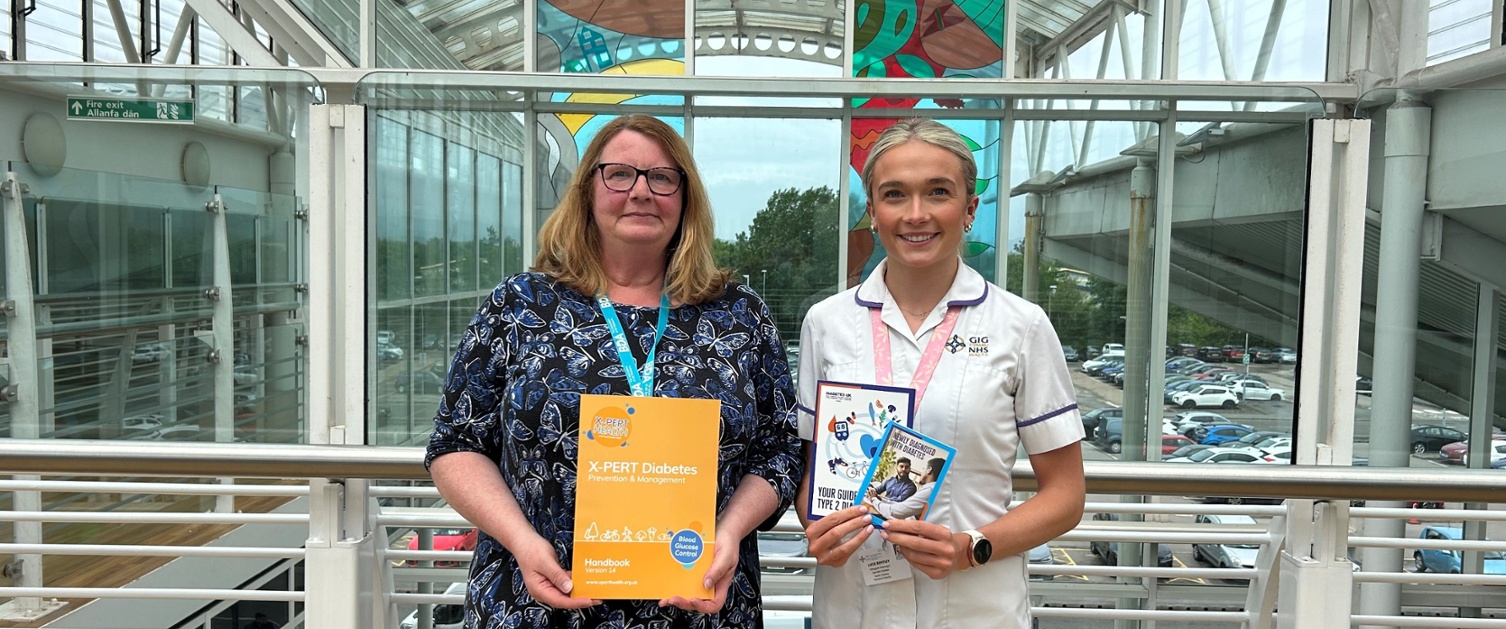
People living with diabetes are being empowered to manage their condition thanks to educational sessions run by dietitians.
There are two different group sessions available to patients in Swansea Bay with type 2 diabetes.
The first is a one-off diabetes awareness session which provides information around how to manage the condition, glucose levels and nutrition, among other things.
While the second, the X-PERT diabetes self-management course, is a national programme which covers a range of themes over six weekly sessions.
Pictured: Debbie Lavelle, nutrition and dietetics community service clinical lead, and Lucie Bentley, diabetes dietitian.
People can either refer themselves to the sessions or can be referred by their GP or practice nurse.
It is hoped that by teaching patients about the chronic condition and its potential long-term effects, they will be given the tools to manage their condition independently.
Swansea Bay’s nutrition and dietetics community service clinical lead, Debbie Lavelle, said: “We offer the two different structured diabetes education groups, so people can choose what is best for them.
“Patients can self-refer or they can be referred by their GP practice too.
“The sessions are both in-person and virtual so people have a choice of what they would prefer. The in-person sessions are held in the community across Swansea and Neath Port Talbot.
“The groups are run by dietitians and are about empowering the patient to look after their diabetes and hopefully we give them the tools to do that.”
The one-off diabetes awareness session lasts around two and a half hours and emphasises the importance of nutrition when it comes to managing the condition.
Lucie Bentley is one of the health board’s dietitians that has delivered both the awareness session and the longer X-PERT self-management course.
“With the diabetes awareness session, we initially provide an explanation of diabetes and talk about lifestyle factors such as stress, sleep, activity and more,” she said.
“We go through how food and weight impact diabetic control, so we talk about carbohydrate awareness and blood glucose values.
“We also talk about the differences between type 1 and type 2, because a lot of people can get those misunderstood, as well as short-term and long-term effects.
“At the end of the session, we make patients aware of the X-PERT course so if they want more information, they can join that.”
Those who take part in the X-PERT programme are given booklets that they can work through at home, in addition to the group sessions.
Similar topics are covered throughout the programme but in greater detail, with a lot of the information more individualised.
Lucie added: “We do find a lot of people who have completed the diabetes awareness session choose to join the X-PERT programme too because they want that continuity.
“We go through everything in a lot more depth. We start off with a health check, so patients can note down their health markers which are relevant to diabetes, and we talk about blood tests and how they relate to diabetes.
“In another session, we go into more detail about carbohydrate awareness, dietary approaches and a nutrition for health session.
“We also look at the psychology of eating, which I think is very beneficial for some of the participants. That session looks at eating behaviours, long term habits, food shopping tips and dining out.
“During the last session, we look at the long-term effects of diabetes and do a recap of everyone’s knowledge.”
Sioned Quirke, Swansea Bay’s Head of Nutrition and Dietetics, said: “Knowledge is power and we want to empower our patients to be able to make choices that will work for them.
“We appreciate that everyone is different and a ‘one size fits all’ approach isn’t always going to work for everyone.
“Therefore, with the knowledge we provide, patients can tailor the advice to suit their lifestyles.”
To find more information about the sessions and to book on, you can email SBU.DiabetesEducationReferrals@wales.nhs.uk or call 01639 862928.
Rydym yn croesawu gohebiaeth a galwadau ffôn yn y Gymraeg neu'r Saesneg. Atebir gohebiaeth Gymraeg yn y Gymraeg, ac ni fydd hyn yn arwain at oedi. Mae’r dudalen hon ar gael yn Gymraeg drwy bwyso’r botwm ar y dde ar frig y dudalen.
We welcome correspondence and telephone calls in Welsh or English. Welsh language correspondence will be replied to in Welsh, and this will not lead to a delay. This page is available in Welsh by clicking ‘Cymraeg’ at the top right of this page.