Award-winner Eleri transforming outcomes for people with cancer that has spread to their spine
A role created just two years ago is already making a huge difference to outcomes for people with cancer that has spread to their spine.
The South Wales Spinal Network, hosted by Swansea Bay, was launched in 2023 with the aim of improving the experience and outcome of patients needing spinal surgery across the region.
Then, the following year, Eleri Lewis took on the newly created role of metastatic spinal cord compression (MSCC) coordinator for west Wales.
And the difference Eleri’s work has made led to her receiving an award at the 2026 UK Acute Oncology Service Conference in Birmingham.
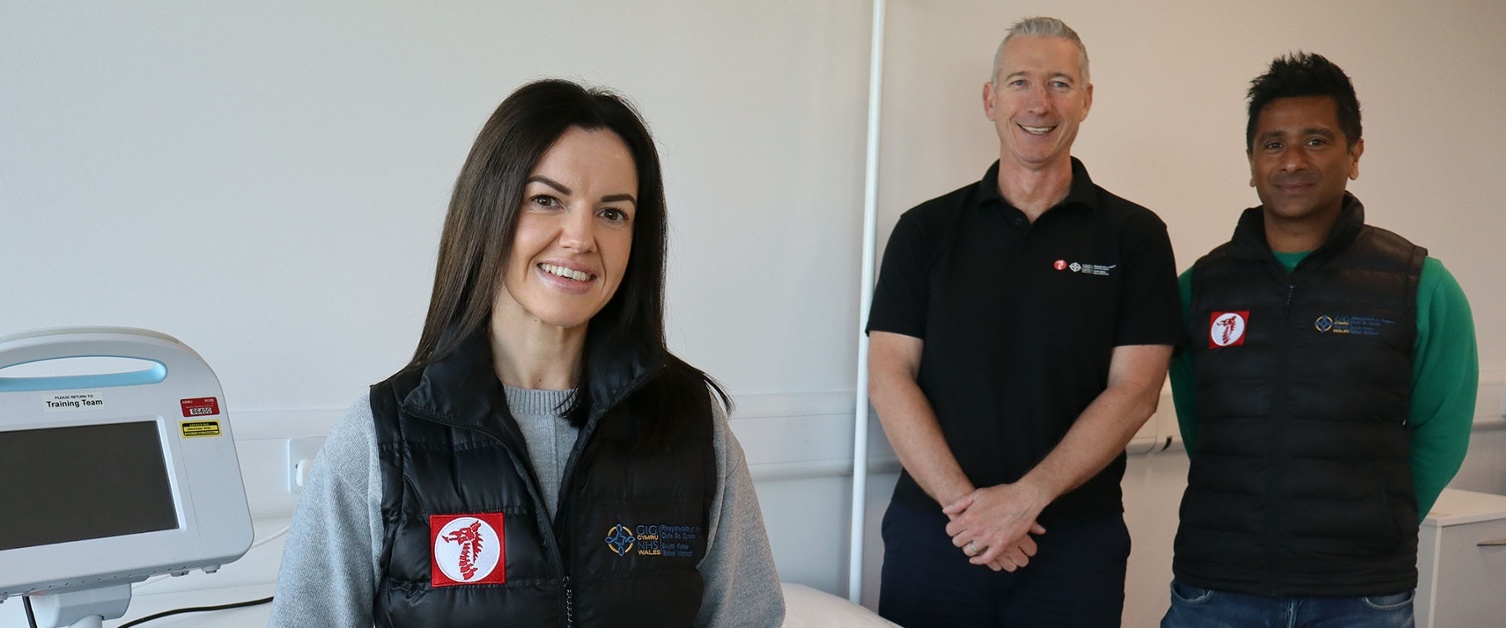
(Main image above shows Eleri with South Wales Spinal Network operational delivery manager Scott Hurford and consultant spinal surgeon Mr Navin Verghese)
MSCC is where a cancer spreads to the bones of the spine and presses on the spinal cord, preventing nerves from working properly.
A similar condition, metastatic cauda equina compression (MCEC), is where the cancer presses on the cauda equina, the bundle of nerves at the base of the spine.
Both are very serious conditions that could lead to paralysis and life-threatening complications.
Consultant spinal surgeon Mr Navin Verghese co-founded the South Wales Spinal Network. He said it was established following recognition that spinal surgery was being delivered in a fragmented, uncoordinated way by multiple providers.
“In the decade leading up to the network’s launch, there were increasing risks building in the system and many events of serious patient harm,” said Mr Verghese.
“For example, with MSCC, many patients did not have access to surgery and the best standard of care because of fragmentation in the pathway.
“That occurred for a number of different reasons, including a lack of communication between different providers, lack of recognition of the patients who needed emergency care, and significant delays at all stages of the patient journey.
“We had multiple episodes of patients coming to harm, losing continence, becoming paralysed because of delays to treatment and because of lack of specific spinal surgical providers recognised in their geographical area.”
The spinal network covers the Swansea Bay, Hywel Dda, Cardiff and Vale, Cwm Taf, and Aneurin Bevan health board areas, along with parts of southern Powys.
Swansea Bay is now the dedicated surgery provider for people from its own area, along with Hywel Dda and some parts of Powys. Surgery for those from the other health boards is provided by Cardiff and Vale.
Eleri’s role is specifically for west Wales. Over a 15-month period she has received around 300 referrals – some of them known to the oncology service but others being identified as having cancer because of MSCC.
“So they’ve not only found out they’ve got cancer, but they have a spinal cord compression as well,” she said. “Their world has been turned upside down in the space of 24 hours.
“Before the coordination service started, there was a lack of communication, fragmented pathways, not knowing who to go to. Medical registrars were having to contact several different specialities.
“The most important part of my role is to take all that chasing away from them. I get the patient details. I contact the different specialties, get everything together and then put it forward to oncology and spinal surgery.”
Previously, fewer than one per cent of patients who presented with MSCC went on to have emergency surgery. Since Eleri started, that has risen to around 10.5 per cent.
Mr Verghese said: “The problem before, the reason we had a one per cent conversion rate, is because the patients were being identified too late.
“They were too poorly at that point and therefore surgery was no longer an option. We also didn't have dedicated commissioned surgical providers in Wales, which we now do.
“Because of Eleri’s role, patients are now being identified earlier. They're getting through the system quickly. They're getting their scans and reports sooner.
“They are getting specialist opinions and being transferred to the surgical and oncology centres rapidly. Ultimately they are then having best practice treatment.”
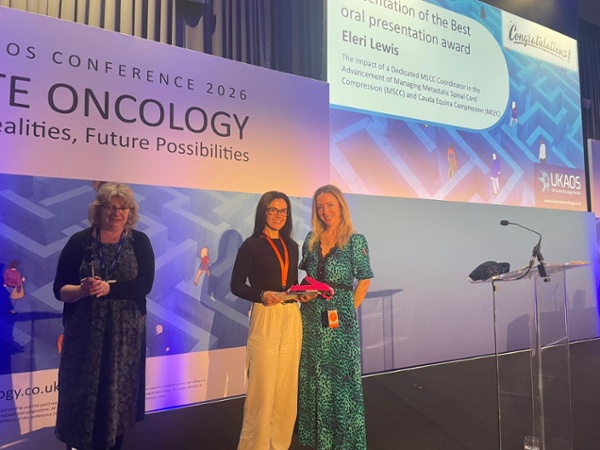 Eleri won the Best Poster and Presentation Award at the UK Acute Oncology Service Conference, after outlining the impact the MSCC coordinator role has had on the advancement of managing MSCC and MCEC.
(Eleri, centre, receives her award from Philippa Jones MBE (left), Independent Acute Oncology Nurse Advisor & Founding Board Member of the UK Acute Oncology Society (UKAOS) and Jo Tutchener Sharp OBE, Founder & CEO of Scamp & Dude)
“When you talk to the acute oncology service team they now have a single point of contact,” she said. “They are not trying to get through to a lot of different people all at once and trying to get everything together.
“The beauty of my role is that I sit in the middle of oncology and the spinal surgeons. I have direct access to them, having built those relationships and communications. It’s much more streamlined.”
Now there are plans to develop her role to help identify patients earlier. Mr Verghese said: “One of the issues across the world is MSCC patients coming into the system or being identified too late.
“Pre-network, we were definitely identifying them too late because there was no one converting to surgery. They were too ill, too unwell and they were paralysed, they were past salvageability.
“Now we're seeing patients earlier in the pathway, and yes, surgery is an option. But our future vision is to find the patients even earlier. Many of them are there in the oncology clinics or in the community with some early symptoms and signs.
“We really want Eleri’s role to be developing systems where we can identify patients earlier and therefore potentially give them non-surgical treatments or minimally invasive surgical treatments.
“Then we can treat them in a far less harmful, minimally invasive way before the cancer becomes too significant in their spine. That's our future vision for this role.”
Rydym yn croesawu gohebiaeth a galwadau ffôn yn y Gymraeg neu'r Saesneg. Atebir gohebiaeth Gymraeg yn y Gymraeg, ac ni fydd hyn yn arwain at oedi. Mae’r dudalen hon ar gael yn Gymraeg drwy bwyso’r botwm ar y dde ar frig y dudalen.
We welcome correspondence and telephone calls in Welsh or English. Welsh language correspondence will be replied to in Welsh, and this will not lead to a delay. This page is available in Welsh by clicking ‘Cymraeg’ at the top right of this page.