Specialist equipment allows more audiology patients to be seen in the community
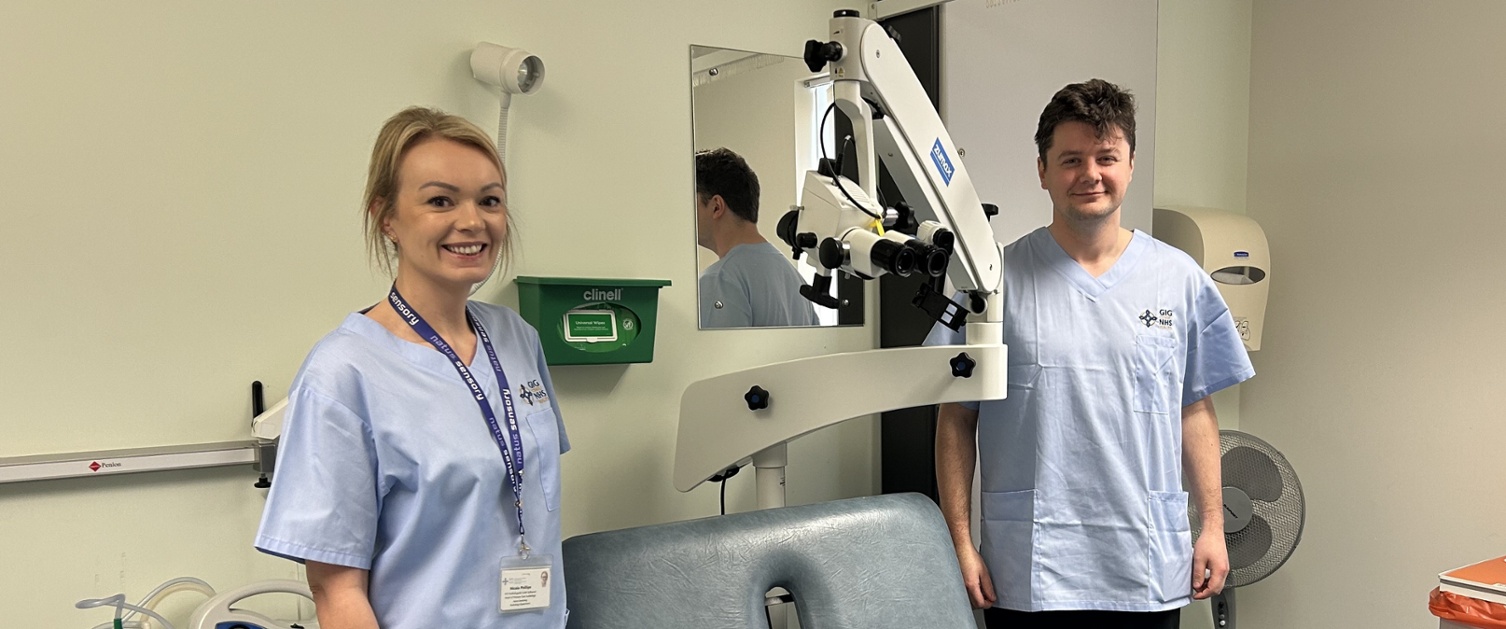
People in Swansea can access more complex ear wax removal closer to home thanks to specialist equipment available in the community.
Bay Health Local Cluster Collaborative (LCC) funded an audiology microscope which is based at the Beacon Centre for Health in SA1.
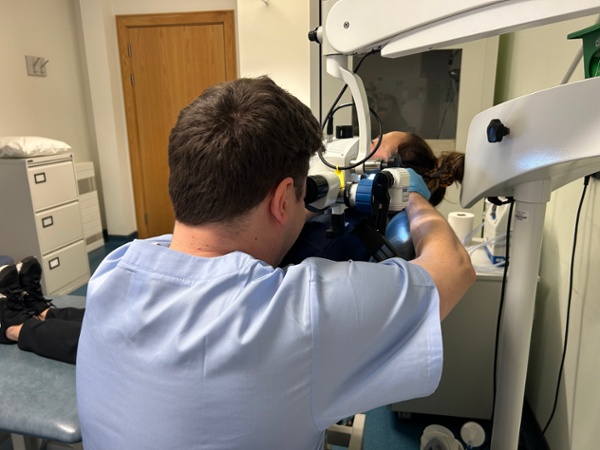
It can be used during more complex ear wax removal procedures, for instance, if a patient has undergone surgery on their ears or has any abnormalities.
Patients would have previously had to wait to be seen by the Ear, Nose and Throat (ENT) team based in hospital, but they can now be seen much sooner and closer to their homes.
Pictured: Nicola Phillips, principal clinical scientist, and Timothy Loescher, clinical scientist.
The team use a second microscope based at Neath Port Talbot Hospital, giving patients the choice to attend whichever site is more convenient for them.
Nicola Phillips, principal clinical scientist who leads the primary care audiology service, said: “Most patients are referred to us following ear surgery or ENT consultant review. But some are also identified as requiring more complex ear clearance during routine primary care audiology clinics.
“With a microscope in Swansea and another in Neath Port Talbot, it helps to offer patients a choice of where is most convenient for them to be seen.
“These patients would previously have been on a hospital waiting list, so it has helped to significantly reduce waiting times for them and relieve some pressure for ENT.”
The microscope has been a positive addition to the primary care audiology service, helping to see even more patients within a community-based setting rather than in hospital.
ENT consultant Mr Paramesh Puttasiddaiah said: “We can refer patients with stable mastoid cavities, for example, to have their wax removed.
“It helps to ease the pressure on the patients who have been waiting to be seen, while we can then see patients who need specialist input.”
The primary care audiology service is made up of designated clinics across Swansea Bay with patients able to phone their GP practice’s triage system and make an appointment for hearing, tinnitus or wax issues.
Advanced practitioners have undergone additional training to be able to perform the more complex wax removal procedures.
“The microscope is used in more complex cases, often for patients who have undergone surgery on their ears which need regular cleaning,” Nicola added.
“We often use video otoscopes to take a photo or video of the ear and email it to an ENT consultant for advice, if needed.
“Having this sort of digital technology available to us, is a great asset in running the service and is an example of modern-day technology enabling collaborative working with our ENT colleagues.”
As well as making the experience more convenient for patients, it has also helped to reduce the demand on the hospital’s ENT service.
Nicola said: “We have been managing just over 90 per cent of the patients referred to us for complex ear wax removal.
“There are only around eight per cent of patients who are referred back to ENT, which is when we feel they need to be seen by a consultant.
“That shows the service is definitely in the right place and is working well.
“It is helping to reduce some of the demand on ENT services, which means the consultants have more time to see the patients which need their expertise.
“It is also positive for our team as it is helping to develop the advanced practitioner role within audiology. This procedure gives the advanced practitioners the opportunity to work at the top of their clinical role.”
Bay Health LCC lead, Dr Nicola Jones, said: “We are delighted to have been able to fund this specialised equipment for patients.
“Our audiology colleagues are putting it to great use treating complex ear problems quickly and without patients needing to attend hospital.”
Rydym yn croesawu gohebiaeth a galwadau ffôn yn y Gymraeg neu'r Saesneg. Atebir gohebiaeth Gymraeg yn y Gymraeg, ac ni fydd hyn yn arwain at oedi. Mae’r dudalen hon ar gael yn Gymraeg drwy bwyso’r botwm ar y dde ar frig y dudalen.
We welcome correspondence and telephone calls in Welsh or English. Welsh language correspondence will be replied to in Welsh, and this will not lead to a delay. This page is available in Welsh by clicking ‘Cymraeg’ at the top right of this page.