Review of blood bottle use could mean fewer tests for thousands of patients
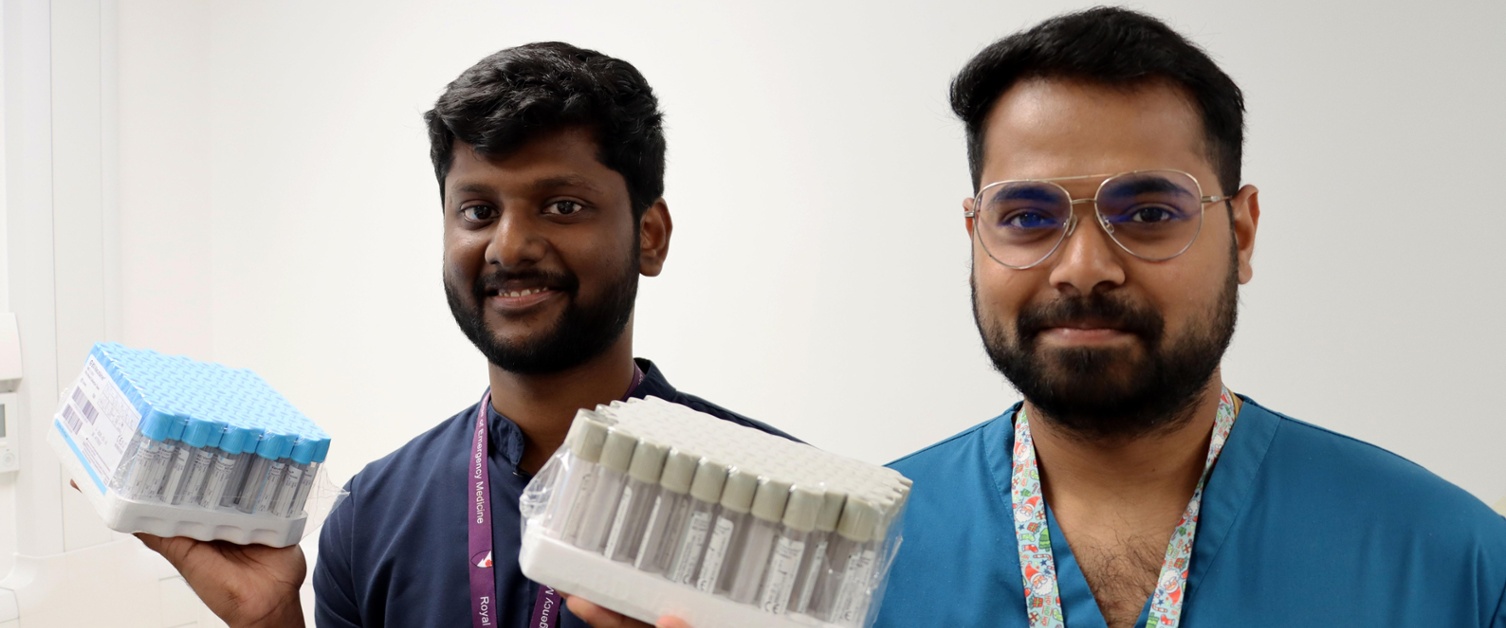
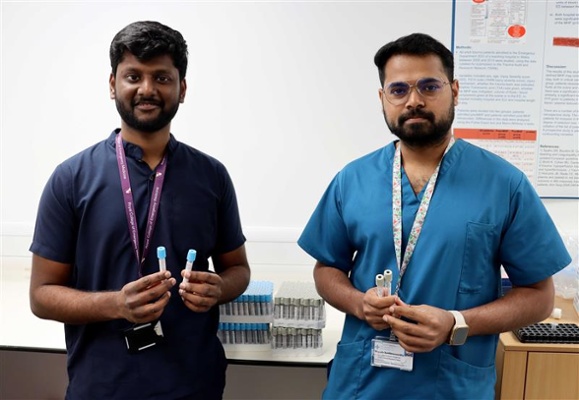
PICTURED: Muthusankar Sudalaimuthu (left) and Bharath Sundaramoorthy with some of the blood test bottles.
A review of the use of blood tests at Morriston Hospital’s busy Emergency Department could lead to 27,000 fewer tests taking each year, without compromising patient care.
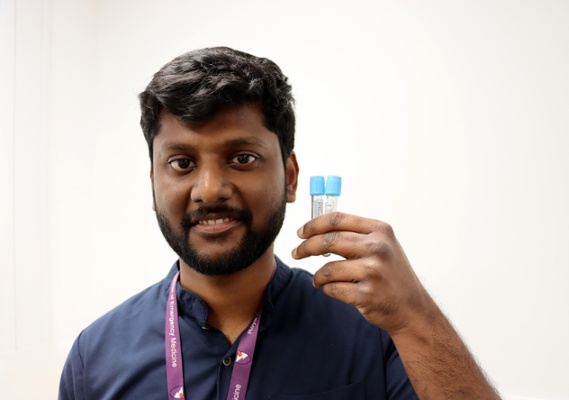 The department identified that some tests where either unnecessary or being duplicated.
The change will see patients undergo fewer tests, saving time for ED clinicians and laboratory staff, along with reducing the health board’s carbon footprint.
The ED project is estimated to deliver carbon emissions savings of around 1,348kg CO2e per year - the equivalent of 674 loads of laundry washed and tumbled dried.
It could also save around £12,000 annually.
Muthusankar Sudalaimuthu, Junior Clinical Fellow, has been leading the project.
Doctor Muthu, as he is known to patients and colleagues, said: “The project focuses on reducing unnecessary use of certain blood bottles in the ED. By optimising test requests, we aim to cut cost without compromising care, reducing our carbon footprint and contribute to the NHS’ net zero goals.
“The project found that sample requests, in many cases, were either not needed because a point of care test had already been taken, or it wouldn’t have added clinical value. If, after clinical review further tests were needed, it is possible to ‘add on’ some tests on samples previously taken provided it is requested within a short time frame of hours.
“As a result of that, all relevant tests will be taken and the change will not affect the quality of care. In fact, it may lead to fewer tests for some patients.
“That also leads to saving time and unnecessary work for our ED staff and in the labs, reducing the production, use and disposal of plastic consumables, along with saving health board funds.
 “This initiative aligns perfectly with our shared commitment to deliver with care, carbon and cost at the heart of every decision benefiting our patients and planet.”
The work forms part of the department’s efforts to achieve silver status by GreenED - a framework developed by the Royal College of Emergency Medicine which encourages environmentally sustainable practices within the specialty of emergency medicine.
ED achieved their bronze status in June 2025 after making a considerable amount of changes to the service’s working methods, including reducing unnecessary cannulation, including a section on sustainable health care during nurse mentor training and reviewing its use of pain relief.
ED Consultant Sue West-Jones, one of three Sustainable Clinical Leads in the health board, said: “Staff in ED are very passionate about the service becoming as sustainable as possible, and Dr Muthu’s project is evidence of that.
“We believe that if a very busy department such as ED can make positive changes and look after our patients, planet and health board finances, then we can achieve so much more throughout our health board.”
Rydym yn croesawu gohebiaeth a galwadau ffôn yn y Gymraeg neu'r Saesneg. Atebir gohebiaeth Gymraeg yn y Gymraeg, ac ni fydd hyn yn arwain at oedi. Mae’r dudalen hon ar gael yn Gymraeg drwy bwyso’r botwm ar y dde ar frig y dudalen.
We welcome correspondence and telephone calls in Welsh or English. Welsh language correspondence will be replied to in Welsh, and this will not lead to a delay. This page is available in Welsh by clicking ‘Cymraeg’ at the top right of this page.