Cabinet Secretary hails Swansea Bay service top of the POPS and virtual wards a 'brilliant concept'
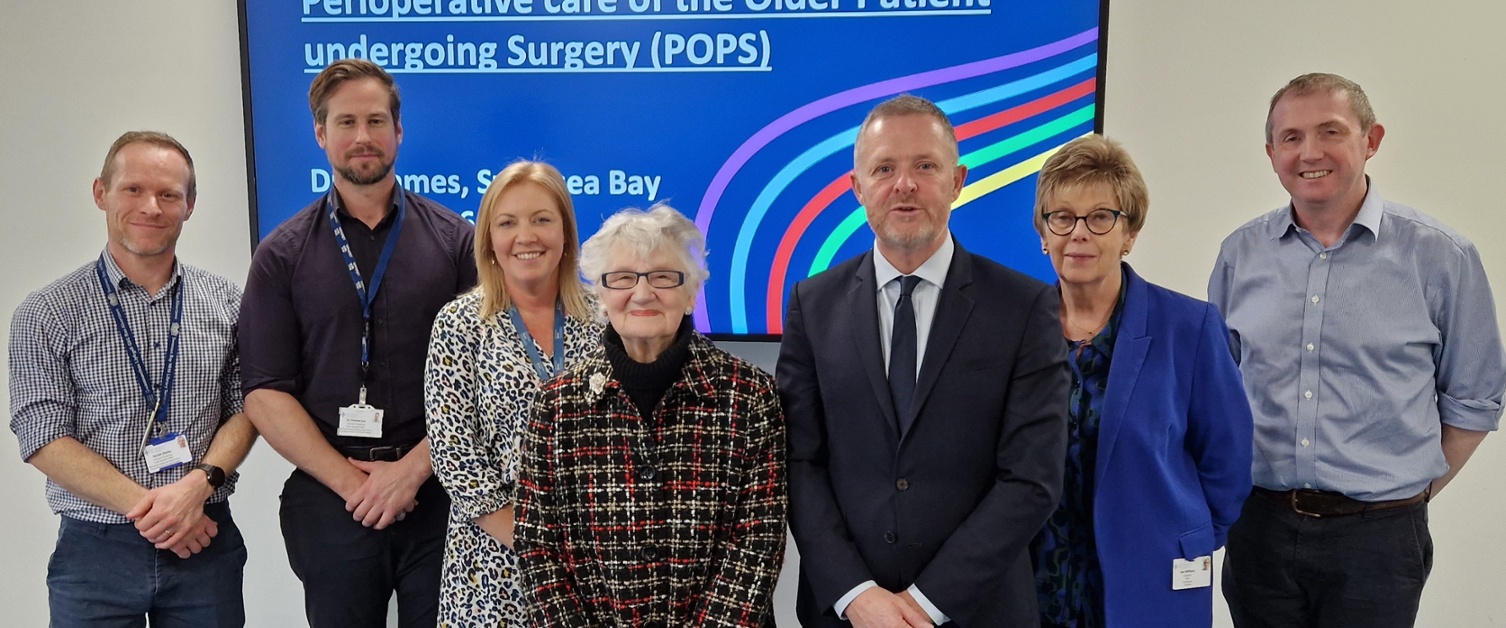
The Welsh Government’s Cabinet Secretary for Health and Social Care, Jeremy Miles MS, has paid a visit to Morriston Hospital to see the work of a highly successful specialist team dedicated to helping people aged 65 and over who are awaiting surgery.
The health board’s Perioperative care of Older People (POPS) team includes doctors and other healthcare professionals who work together to help manage any issues older patients may have before their operations.
Mr Miles also enjoyed a presentation about the Swansea Bay virtual wards service, which as supported more than 12,000 patients in their own homes – freeing up hospital beds – since its inception in 2021.
As well as hearing about the benefits of the POPS service and Virtual Wards services, he also met a former POPS patient.
Mr Miles said: “It was fantastic to see the POPS service at work today. It’s really great to see people being diverted from invasive treatment that they might not need or being given other options when they are frail.
“It was incredibly reassuring to hear from a patient herself – the positive experience that she had. I want to say a huge thank you to the team.”
On the virtual wards he added: “I think virtual wards are a brilliant concept, and it’s great to see Swansea Bay innovating and leading the way, not just in Wales but right across the UK.
“I want to congratulate the team for what is obviously and excellent service.”
Patients who are referred to a POPS clinic are offered an appointment with a member of the team usually lasting around 30 minutes.
The appointment may include a review of their medical history and any medications they take, a physical examination, a chat about their lifestyle and how they manage at home, with some questions about their memory and mood.
They may also carry out some simple checks like a urine sample, walking test, weight, or blood pressure while sitting and standing.
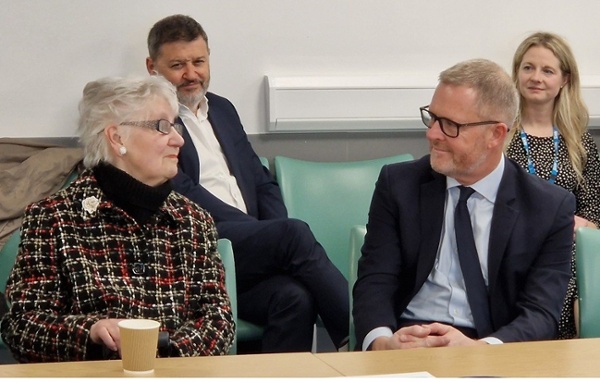
Former POPS patient, Shirley Skyrme (above with Jeremy Miles), agreed to share her story with the meeting.
She said: “My journey has been tremendous. I always see pieces in the paper criticising the NHS but when I went into prehab, I’ve never had such treatment.
“The prehab team really gave me back my confidence, which is so important. Having been told that there was nothing that they could do for me, I had an inoperable tumour on the colon, I suppose my age was taken into account, I’m 90 in June, they must have thought there’s no hope for this old bird.
“But they took me under their wing and I have never had such treatment anywhere. On the ward, if I called for someone, they would ask what I wanted, they would come immediately, and see to my needs. You cannot fault that.
“How can people write and criticise them? I would never criticise them – I owe them my life. I really do. I can’t speak highly enough of them. I haven’t got one bad word to say against them. I’m here today because of the NHS, and they have my eternal thanks.
“To everyone, whatever department you are from, from the bottom of my heart, I thank you. I’m here today because of all of you.”
Karina James, a consultant in geriatric medicine, said: “POPS is about finding the patients out there who are living with frailty who are considering an elective operation or have had one in an emergency. The aims of the service include optimising the patient, making a clear shared decision about an operation and its risks, with the patient and family and providing support during their hospital stay.”
Patients can be referred to the service by surgeons or anaesthetists, while others are identified through a digital questionnaire that assess whether the patient is living with frailty.
Dr James warned that demands upon POPS were set to grow in the coming years.
She said: “Our population is aging; it’s thought that in 2030 around 20% of patients having operations will be over 75. We know that lots of those patients living with frailty have a longer hospital stay and a higher chance complications happening during their operation, so we really need an efficient service to offer them.”
Thankfully, the service has been a great success.
Dr James said: “We started in 2023 and it was very much an ad hoc service but we now have a team of two resident doctors, admin staff and a consultant covering the service.
“We have managed to see over 70% of emergency patients within the last year in Morriston and just over 1,000 elective patients have been screened for frailty.
“In terms of general surgical waiting lists, they are a tenth of what they were three years ago through the combined hard work of all the specialities involved, patients have also reported greater satisfaction in their journey.”
Dr James welcomed the opportunity to showcase POPS to the Cabinet Secretary.
She said: “It’s always nice to showcase your work. I think, ultimately, it’s still a relatively new service in Swansea Bay, so we have to take these opportunities to really show the benefits, otherwise the service isn’t going to be able to grow and continue doing what it is doing now.
“Cardiff and Vale has a similar service, set up slightly before us, and as two health boards we’re really showing a difference. We have adapted our services slightly differently across the health boards depending on demand, but we are really showing that we can make a difference.”
The virtual wards service was initially set up as a pilot project in November 2021 but proved so successful that it was later rolled out with a virtual ward now running within all eight Local Cluster Collaboratives (groups of GP surgeries).
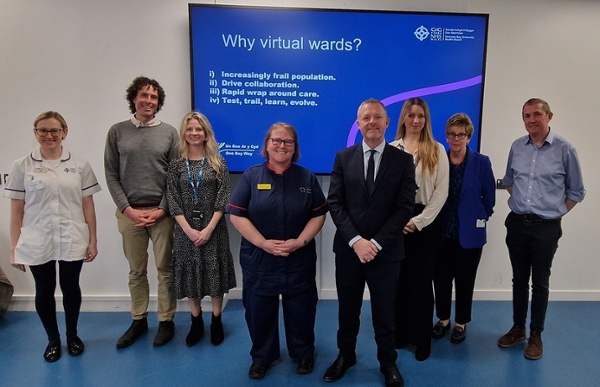
Above (left to right): Isabelle Williams (VW Dietician), Neil Hapgood (VW Service Implementation Manager), Katy Silcox (VW Occupational Therapist Lead), Jo Gwilym-Edwards (VW Lead Nurse), Jeremy Miles, Sheree Breckon (VW Physiotherapy Lead), SBUHB Chair Jan Williams, Rhodri Edwards Consultant Geriatrician.
Virtual wards provide wraparound support in the community to people with complex health and social needs.
Rather than a ward being made up of hospital beds, the patient’s own bed becomes part of a virtual ward, meaning they still receive face-to-face care but in the comfort of their homes.
A multi-disciplinary team made up of health and care professionals, such as doctors, nurses, pharmacists and therapists, discuss how to plan and manage each patient’s care, ensuring face-to-face assessment and intervention is completed.
Digital technology is used to pull the large teams together virtually, making communication and care planning more efficient and effective.
Jo Gwilym-Edwards, lead nurse for virtual wards, played a part in the presentation and hailed the service.
She said: “We were one of the first virtual wards in Wales, each health board within Wales has a different model, our model has been applauded across the whole of the UK for its engagement with the primary sector, the third sector and our colleagues in secondary care as well.
“We’re victims of our own success - we are growing rapidly. We started as a pilot across half the health board four years ago, within nine months we rolled it out so it was regional.”
As with POPS virtual wards help free up hospital beds and save money.
Jo said: “It’s about preventative work. We get to the patient before they reach crisis point. And secondly, it facilitates early discharges or avoiding admissions into hospital. We work from the front doors, ED, AEU and OPAU – we will take those patients home rather than them being kept in hospital.
“We also go to the wards and will bring people home earlier where we can. Ideally, we prevent them having to come into hospital in the first place.”
Jo also welcomed the opportunity to share their work with the Cabinet Secretary.
She said: “It’s great to see the Cabinet Secretary visiting. We need to advertise what we do because what we do is provide an outstanding service – and he’s the person who has the power to make it bigger and better.”
Swansea Bay Chair, Jan Williams, said: “We were delighted to welcome the Cabinet Secretary Jeremy Miles to Morriston to see our ground-breaking, award-winning Perioperative care of Older People service.
“It’s really ensuring a number of older frail people can access surgery in ways that they wouldn’t otherwise have been able to do, and return home and carry on living their lives with better health as a consequence of the outcome of the surgery.
“We are so very proud of the service, and know that the population of Swansea Bay welcome this – it really is an excellent service for the whole community.
“The virtual wards, again, are a brilliant way of keeping people out of hospital, or getting home from hospital, to return to their homes, to return to their communities and live their lives, at home, with support rather than being in what can be a very alien environment in hospital, particularly if you don’t really need to be there.
“The virtual wards service that we offer is ground-breaking and we know just how much the population values it. We are very proud of all our staff who operate it.”
* The POPS service is supported by the Bevan Commission’s Bevan Exemplar Programme and earlier this year won the Professor Sir Mansel Aylward Award for Outstanding Innovation at a special showcase held at the Senedd.
Main pic caption: (left to right): Isabelle Williams (VW Dietician), Neil Hapgood (VW Service Implementation Manager), Katy Silcox (VW Occupational Therapist Lead), Jo Gwilym-Edwards (VW Lead Nurse), Jeremy Miles, Sheree Breckon (VW Physiotherapy Lead), SBUHB Chair Jan Williams, Rhodri Edwards Consultant Geriatrician.
Rydym yn croesawu gohebiaeth a galwadau ffôn yn y Gymraeg neu'r Saesneg. Atebir gohebiaeth Gymraeg yn y Gymraeg, ac ni fydd hyn yn arwain at oedi. Mae’r dudalen hon ar gael yn Gymraeg drwy bwyso’r botwm ar y dde ar frig y dudalen.
We welcome correspondence and telephone calls in Welsh or English. Welsh language correspondence will be replied to in Welsh, and this will not lead to a delay. This page is available in Welsh by clicking ‘Cymraeg’ at the top right of this page.