Recovering from anterior stabilisation

What is anterior stabilisation?
This surgery involves the repair of the torn cartilage (connective tissue) within the socket of the shoulder joint. This, in addition to physiotherapy rehabilitation, will improve the stability of the shoulder. The surgery may be carried out by a type of keyhole surgery where only small cuts are made, which means you get better quicker. This is known as arthroscopy. Or it might be an open procedure resulting in a 3–4 inch wound on the front of the shoulder above the armpit.
Skip straight to exercises after surgery.
Skip straight to frequently asked questions.
What happens after surgery?
Your arm will feel numb when you wake due to a nerve block being used in addition to the general anaesthetic. This will wear off in around 24 hours.
Your arm will be supported in a sling and swathe - this stops the arm and shoulder moving - which MUST to be worn day and night for the next four weeks. The sling can be removed when you need to wash and do the exercises.
You may return from theatre with an extensive padded dressing on your shoulder, below this there will be a small dressing protecting the wound. You MUST remove the large dressing within 2 days of the operation to avoid skin irritation but leave the small dressing below this undisturbed.
You will return to the outpatient clinic for review within 2 weeks of the surgery, during which your stitches and dressings will be removed.
If for any reason your outpatient appointment is delayed, then you must arrange to have your stitches taken out and dressings removed in your local GP surgery.
Ward physiotherapy
Your ward physiotherapist will demonstrate the appropriate exercises to be completed the day after surgery until your initial outpatient physiotherapy appointment. These exercises are to be completed 2-3 times a day.
Your exercises will be restricted for the first few weeks to allow the repair to heal.
Shoulder precautions
Initially it is important that you do not overstretch, especially rotating your arm away from your body or trying to take your arm past shoulder height and behind your back.
Your physiotherapist will teach you how to remove and put on the sling.
If you have any problems on discharge, please contact the ward physiotherapist on the appropriate number shown in the homepage.
Exercises after your surgery
The physiotherapist will encourage you to complete the following exercises after your surgery.
These exercises should be done from day one until full recovery.
Do exercises 3-4 times a day.
-
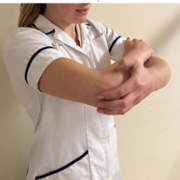
Stand or sit. Lift your operated arm up and away from your chest using your other arm as far as comfort allows - not past shoulder height. Repeat 10 times. Image shows a physiotherapist demonstrating the exercise. Both arms are at chest height with the forearms across the body pointing towards each other. The left hand is supporting the elbow of the right arm. The right hand is resting on the left arm.
-
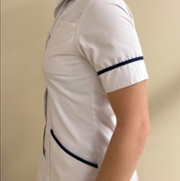
Stand or sit. This exercise can be done when your arm is in a sling. Move your shoulder blades gently back and down (small movement). Hold for 5 seconds. Repeat 10 times. Image shows a physiotherapist demonstrating the exercise. They are stood up straight with their shoulders gently moved back and down.
-
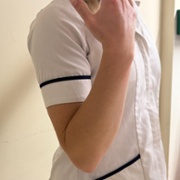
Stand. Bend your elbow and then straighten your elbow. Repeat 10 times. Image shows a physiotherapist demonstrating the exercise. They are stood up, with their right arm bent at the elbow and their forearm pointing upwards with the palm of their hand facing towards their shoulder.
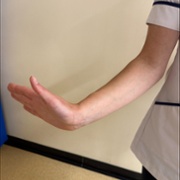
- Move your wrist back and forth. (Can be done in and out of the sling.) Repeat 10 times. Image shows a physiotherapist demonstrating the exercise. They are stood up. Their right hand is turned outwards from the wrist.
Rydym yn croesawu gohebiaeth a galwadau ffôn yn y Gymraeg neu'r Saesneg. Atebir gohebiaeth Gymraeg yn y Gymraeg, ac ni fydd hyn yn arwain at oedi. Mae’r dudalen hon ar gael yn Gymraeg drwy bwyso’r botwm ar y dde ar frig y dudalen.
We welcome correspondence and telephone calls in Welsh or English. Welsh language correspondence will be replied to in Welsh, and this will not lead to a delay. This page is available in Welsh by clicking ‘Cymraeg’ at the top right of this page.