Recovering from a reverse total shoulder replacement

What is a reverse total shoulder replacement?
This surgical procedure involves replacing the damaged shoulder joint with a special type of shoulder replacement, which is used when the muscles immediately around the shoulder joint are not working.
This replacement does not rely on the rotator cuff muscles to support it as the design is different and is known as a “reverse prosthesis” where the ball and socket positions are reversed which provides more stability. The patient is given a general anaesthetic and a nerve block to numb the arm.
Skip straight to exercises after surgery.
Skip straight to frequently asked questions.
What happens after surgery?
You may wake up with a numb arm following surgery. This is normal and is a result of the nerve block which will wear off gradually over 24 hours.
You will be wearing a sling when you wake up. Your physiotherapist will provide you with additional information.
You will experience post-operative pain from the surgical procedure, but it may feel different from how it did before the surgery.
You will have a check X-ray prior to discharge.
Ward physiotherapy
Your ward physiotherapist will demonstrate how to remove and put on your sling.
Your sling can be removed to complete the exercises 3-4 times a day and can usually be discarded following your clinic appointment 10-14 days later.
If you have any problems on discharge, please contact the ward physiotherapist:
Telephone Neath Port Talbot Hospital on 01639 862652.
Shoulder precautions
Due to the nature of the surgery it is very important that you do not try and put your hand behind your back or rotate your arm too far away from your stomach to protect the muscle on the front of the shoulder.
Exercises after your surgery
The physiotherapist will encourage you to complete the following exercises after your surgery.
These exercises should be done from day one until full recovery.
Do exercises 3-4 times a day.
-
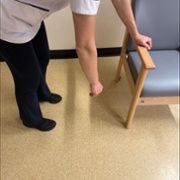
Pendulums. Stand leaning on a table with one hand. Let your other arm hang relaxed straight down. Swing your arm as if drawing a circle on the floor. Change direction. Repeat 10 times. Image shows a physiotherapist demonstrating the exercise. They are standing up and facing a chair. There is a gap between their feet and the chair. They are leaning forward with their left hand firmly on the arm of the chair. Their right arm is hanging straight down.
-
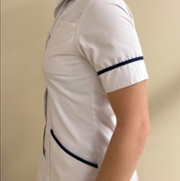
Stand or sit. (Can be done in and out of the sling.) Move your shoulder blades gently back and down (small movement). Hold 5 seconds. Repeat 10 times. Image shows a physiotherapist demonstrating the exercise. They are stood up straight with their shoulders gently moved back and down.
-
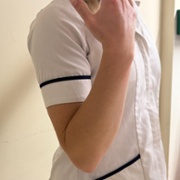
Stand. Bend your elbow and then straighten your elbow. Repeat 10 times. Image shows a physiotherapist demonstrating the exercise. They are stood up, with their right arm bent at the elbow and their forearm pointing upwards with the palm of their hand facing towards their shoulder.
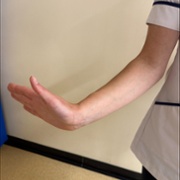
- Move your wrist back and forth. (Can be done in and out of the sling.) Repeat 10 times. Image shows a physiotherapist demonstrating the exercise. They are stood up. Their right hand is turned outwards from the wrist.
Rydym yn croesawu gohebiaeth a galwadau ffôn yn y Gymraeg neu'r Saesneg. Atebir gohebiaeth Gymraeg yn y Gymraeg, ac ni fydd hyn yn arwain at oedi. Mae’r dudalen hon ar gael yn Gymraeg drwy bwyso’r botwm ar y dde ar frig y dudalen.
We welcome correspondence and telephone calls in Welsh or English. Welsh language correspondence will be replied to in Welsh, and this will not lead to a delay. This page is available in Welsh by clicking ‘Cymraeg’ at the top right of this page.