Podiatry project which drastically reduced waiting times earns national attention
A community-based podiatry project has received national recognition after reducing waiting times of up to two years to just two weeks for patients.
Initially developed within City Health Local Cluster Collaborative (LCC), it has also helped to reduce potential life and limb-threatening vascular complications too.
The podiatry-led model is for patients with peripheral arterial disease (PAD), a condition where narrow arteries reduce blood flow to the legs.
Data collected by the team identified long waits in Swansea Bay, which can lead to avoidable deterioration.
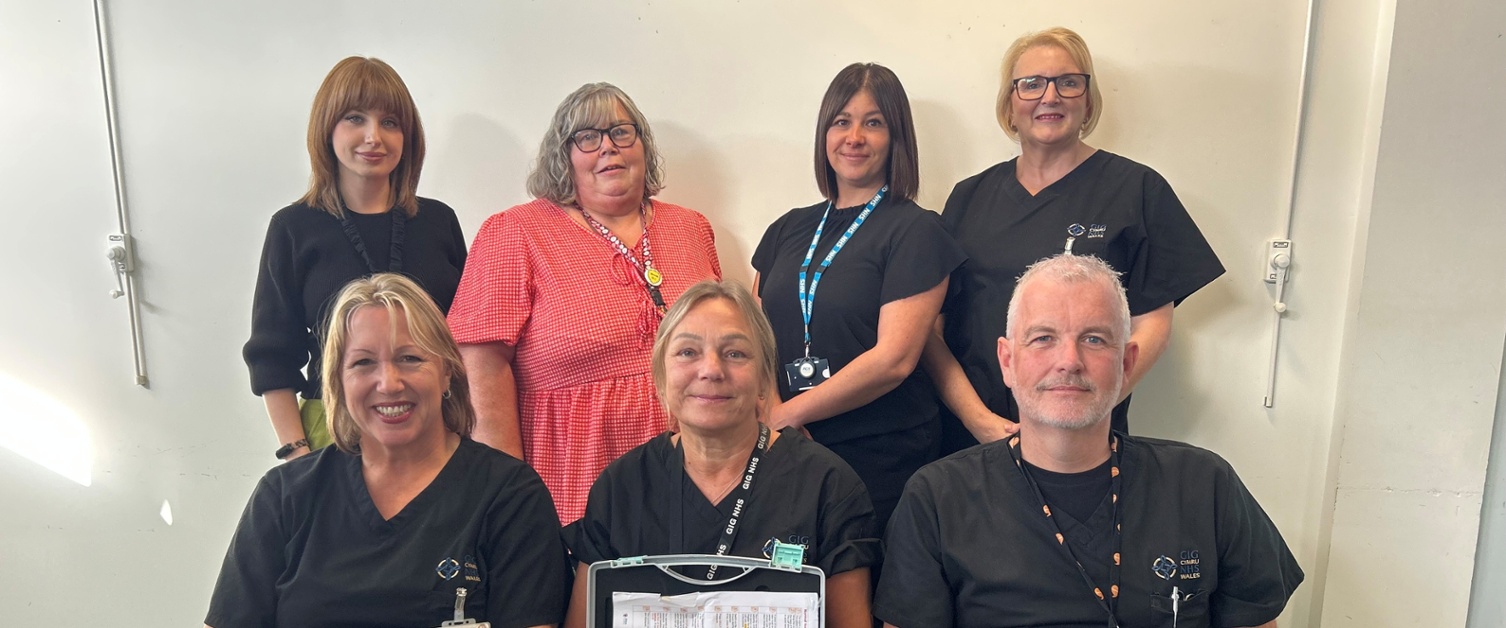
Pictured (back row): Adrienne Phillips, business support officer, Kathrin Jones, assistant business support manager, Kelly John, business support manager, Kath Brenton, Assistant Head of Podiatry and orthotics clinical lead, (front row): Keri Hutchinson, Deputy Head of Podiatry, Orthotics, Persistent Pain & ALAS Prosthetists, Sally Bloomfield, Head of Podiatry, Orthotics, Persistent Pain & ALAS Prosthetists, Heddwyn Phillips, clinical lead podiatrist.
Podiatrists worked with the cluster to redesign the pathway and developed a community-based single rapid access point for assessment, definitive diagnosis and escalation.
Of the 131 patients reviewed in the cluster pilot 89 per cent were managed through the new model and did not require referral to the hospital-based vascular team.
As a result, the project has now been shortlisted in the NHS Wales Timely Care Award category at this year’s NHS Wales Awards.
Sally Bloomfield, Swansea Bay’s Head of Podiatry, Orthotics, Persistent Pain & Artificial Limb and Appliance Service, said: “PAD is a significant, under-recognised condition, particularly among those living with long-term conditions such as diabetes.
“Delays in definitive diagnosis and intervention result in preventable harm including, ulceration, amputation and cardiovascular events.
“Demand on secondary care created fragmented pathways, causing prolonged waits, and resulted in patients going to the Emergency Department and escalating demand across the system.
“We felt the need to redesign the pathway to improve access, reduce delays and help with proactive identification and early intervention – shifting from a reactive to a preventative approach within a community setting.
“Through funding from City Health LCC, we created the single community access point, enabling timely decision‑making and faster access to assessment, diagnosis and treatment closer to home.”
The Podiatry Vascular Cluster Model provides direct access to advanced podiatrists, point-of-care diagnostics and immediate clinical decision-making.
Patients benefit from quicker triage, earlier diagnosis and faster escalation to specialist services, if needed.
In conjunction with the cluster project, the podiatry service also undertook a review of the hospital vascular waiting list.
Using the new cluster-based model almost 300 patients could be removed from the list.
Instead, they were given a diagnosis and relevant signposting through a non-medically led pathway, helping to improve capacity.
Sally added: “When we initially looked at the hospital list, we identified 613 patients who were potentially appropriate for podiatry-led review. This highlighted a significant opportunity to reduce unnecessary demand and delays.
“With the cluster pilot, we were able to see or offer all patients a vascular assessment and onward plan within two weeks, compared to historical waits of up to two years.
“The results showed that most patients could be safely managed within the cluster podiatry-led service, with only a small proportion requiring a hospital referral.
“It also confirmed that our advanced podiatrist-led assessment and diagnostics could safely replace the previous referral pathways, with patients now given a diagnosis at the earliest opportunity.
“Testing also demonstrated improved triage accuracy, reduced diagnostic uncertainty and more appropriate use of specialist services where needed.”
Singleton Hospital’s podiatry clinic was used for the cluster pilot appointments, as well as the vascular waiting list element.
A number of community-based settings were also used, allowing more patients to be seen closer to home.
Sally said: “This project demonstrated that redesigning pathways, not adding capacity, can transform vascular care and improve cardiovascular outcomes.
“Podiatry is uniquely placed to deliver first contact expert assessment of lower limb vascular symptoms, definitive diagnosis, self-management support, recommendations for treatment and signposting as required.
“Earlier detection of high-risk patients, including undiagnosed PAD and cardiovascular risk, prevented progression and reduced demand on both secondary and primary care.
“The model demonstrates a whole system shift from two-year waits to two-week access, delivering the right care, in the right place, at the right time, while improving flow, reducing delays and preventing avoidable harm.”
Now, the team must wait until later this month when the winners of this year’s NHS Wales Awards will be announced at an event in Cardiff.
Speaking of being shortlisted, Sally added: “This achievement reflects the dedication and collaboration of our teams and partners in delivering innovative, patient-centred care.
“We are particularly grateful to our City Health Cluster colleagues for supporting the pilot phase of the model, which has generated valuable evidence to inform the future provision and sustainability of this approach.
“The recognition highlights the positive impact that integrated, community-based vascular services can have for patients across our population and the value of advanced podiatric practice enabling a safe, effective alternative to traditional referral pathways.”
Due to the project’s success, it is now being trialled in another Swansea Bay cluster.
Dr David Howell, City Health LCC lead and GP partner at Kingsway Surgery, said: “The project has been a huge success, delivering significant benefits for our patients.
“It enabled patients with suspected PAD or concerns about their peripheral circulation, identified by their GP, to be assessed very quickly by the specialist vascular podiatry team.
“Alongside timely assessment, patients benefited from wider preventative interventions, including cardiovascular risk factor screening for conditions such as atrial fibrillation and hypertension, as well as smoking cessation advice.
“These interventions were particularly valuable given that patients would otherwise have faced waiting times of over 12 months to see the vascular consultant team.
“Early assessment and intervention have helped patients access appropriate care sooner, while reducing unnecessary onward referrals and contributing to a significant reduction in overall vascular waiting times.
“Importantly, identifying and addressing vascular problems earlier also has the potential to prevent disease progression, reduce late presentations and lower the risk of avoidable amputations in patients with at-risk limbs.”
Rydym yn croesawu gohebiaeth a galwadau ffôn yn y Gymraeg neu'r Saesneg. Atebir gohebiaeth Gymraeg yn y Gymraeg, ac ni fydd hyn yn arwain at oedi. Mae’r dudalen hon ar gael yn Gymraeg drwy bwyso’r botwm ar y dde ar frig y dudalen.
We welcome correspondence and telephone calls in Welsh or English. Welsh language correspondence will be replied to in Welsh, and this will not lead to a delay. This page is available in Welsh by clicking ‘Cymraeg’ at the top right of this page.